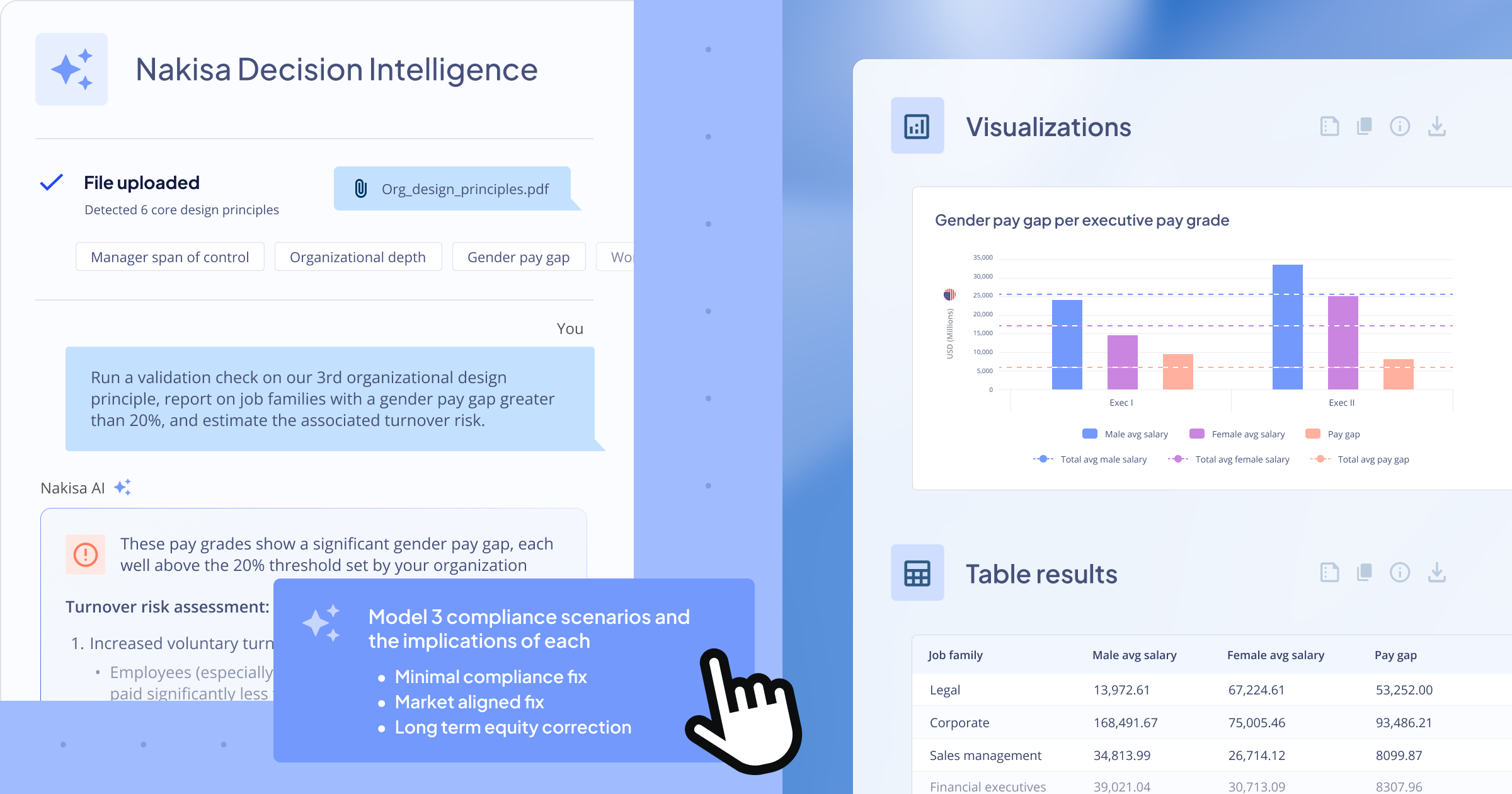
The importance of organizational design principles
Organizational design principles are critical guardrails that protect workforce health and business performance. When organizations properly validate and apply these principles, they benefit from:
- Stronger financial performance: Companies that use people analytics to optimize organizational decisions achieve three-year average profits that are 82% higher than competitors.
- Improved productivity and morale: Fair compensation, balanced workloads, and clear structures keep teams engaged and performing at their best.
- Lower turnover and higher retention: Employees stay when structures support them, managers aren't overloaded, and pay is equitable.
- Reduced compliance and reputational risk: Proactively addressing pay gaps and structural imbalances helps protect against legal exposure and talent loss.
Unfortunately, many organizations rely on traditional validation methods, such as manual audits, spreadsheet analysis, quarterly HR reports, which are often too slow, may fail to capture all issues, and rarely provide a clear path to resolving them once identified. This becomes even more critical for large, global organizations, where organizational complexity, geographic dispersion, regulatory differences, and constant workforce changes make continuous validation significantly more challenging.
How to validate your organizational design principles: demo of Nakisa Decision Intelligence (NDI)
We've seen how important validating organizational design principles. Now let's look at how NDI makes testing, validating, and modeling scenarios to comply with these principles fast and intuitive.
In this walkthrough, we use simple conversational prompts to review our org design principles, validate them, and generate an actionable remediation plan with measurable impact, helping informed decisions in just a few minutes.
You can also watch the full video demonstration below:

Uploading custom rules and principles
NDI allows organizations to upload documents containing their guardrails or organizational design principles. In this demo, we uploaded a file outlining our organization's design principles.
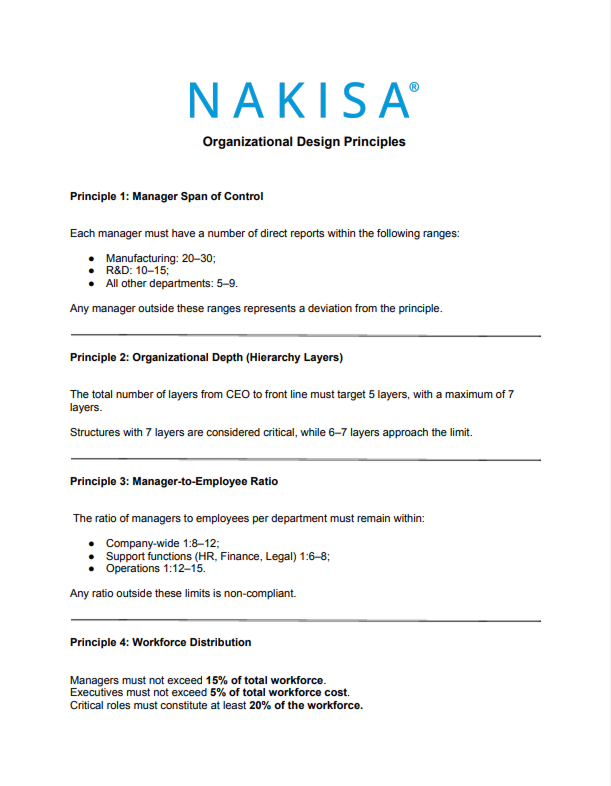
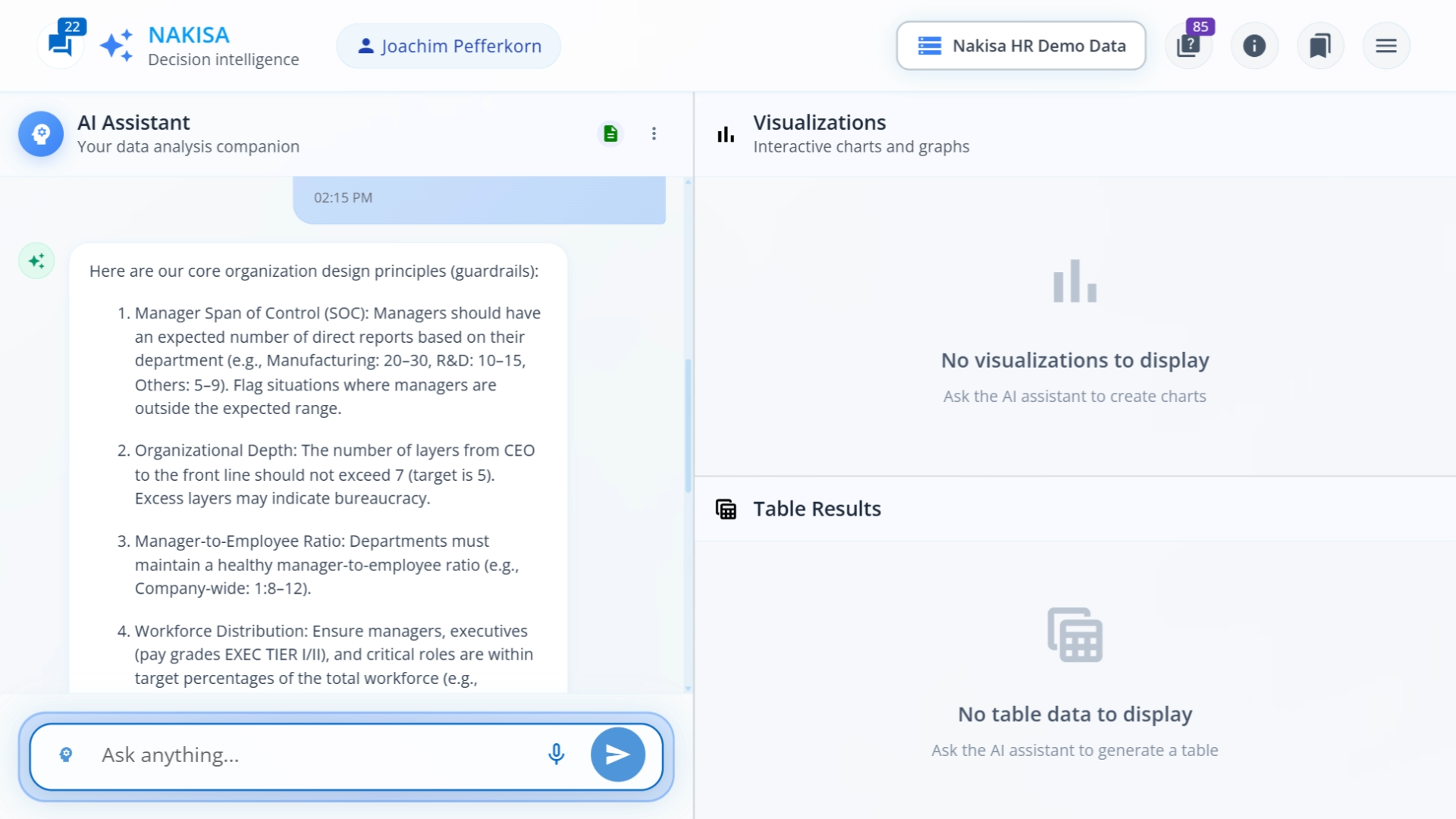
Prompt: “What are our organization design principles?”
The system has learned our principles and presents them in an easy-to-read format. You can also click suggested replies to explore additional context or deeper explanations.
Most organizational design principles typically relate to one of the following:
- Workforce composition
- Workforce costs
- Workforce structure
In this post, we’ll walk through examples of all three, drilling down into specific use cases using NDI.
Reviewing rules and drilling down into potential issues
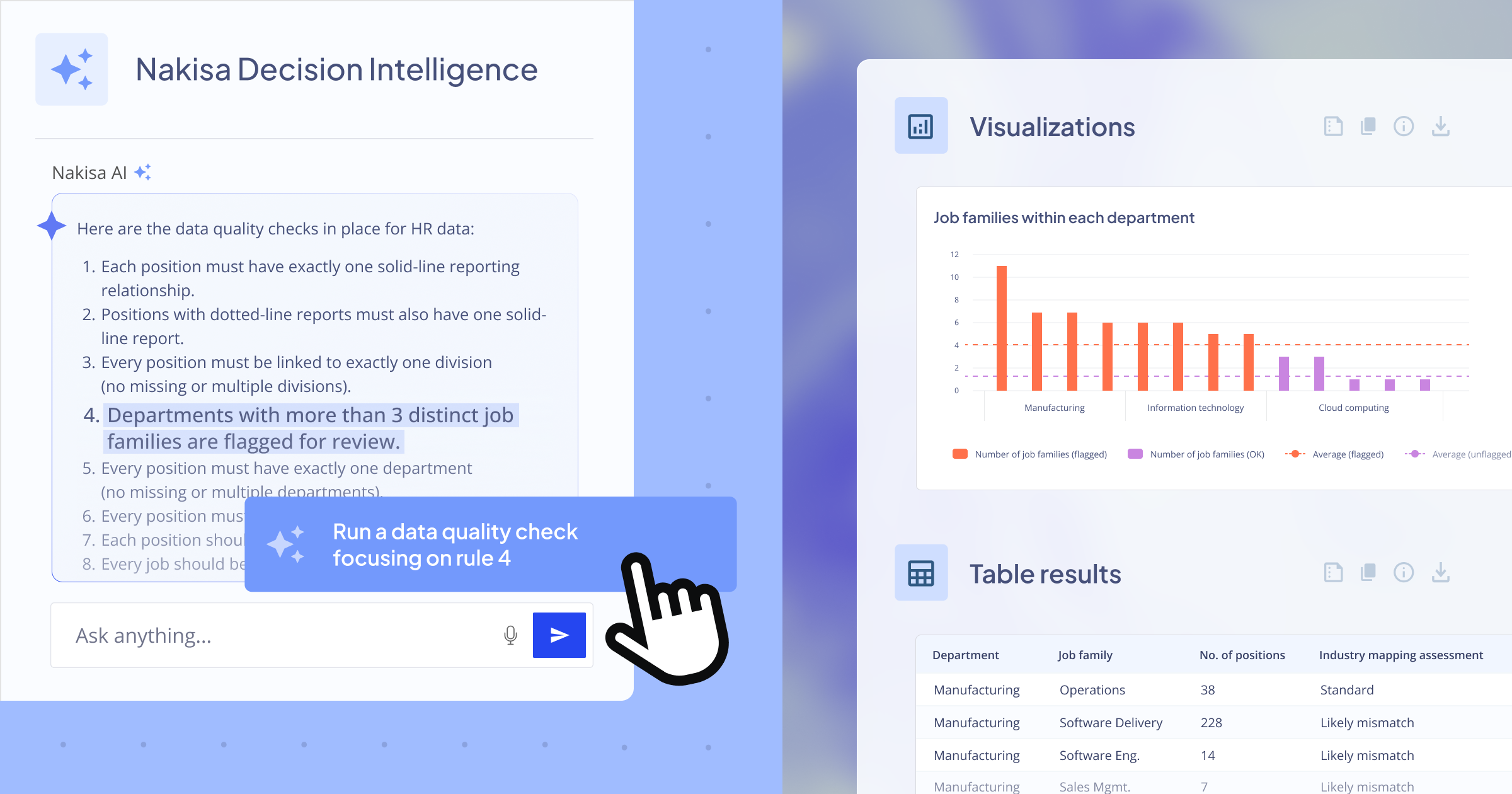
We begin by validating our workforce data against the fourth design principle, which focuses on workforce distribution, including target ratios for managers, executives, and critical roles in our broader workforce.
Prompt: “Run a validation check on our fourth organization design principle and indicate any deviations from our expected distributions.”
NDI analyzes workforce data and confirms whether the current workforce distribution aligns with these targets. At a high level, the results show that managers, executives, and critical roles all fall within the expected ranges.
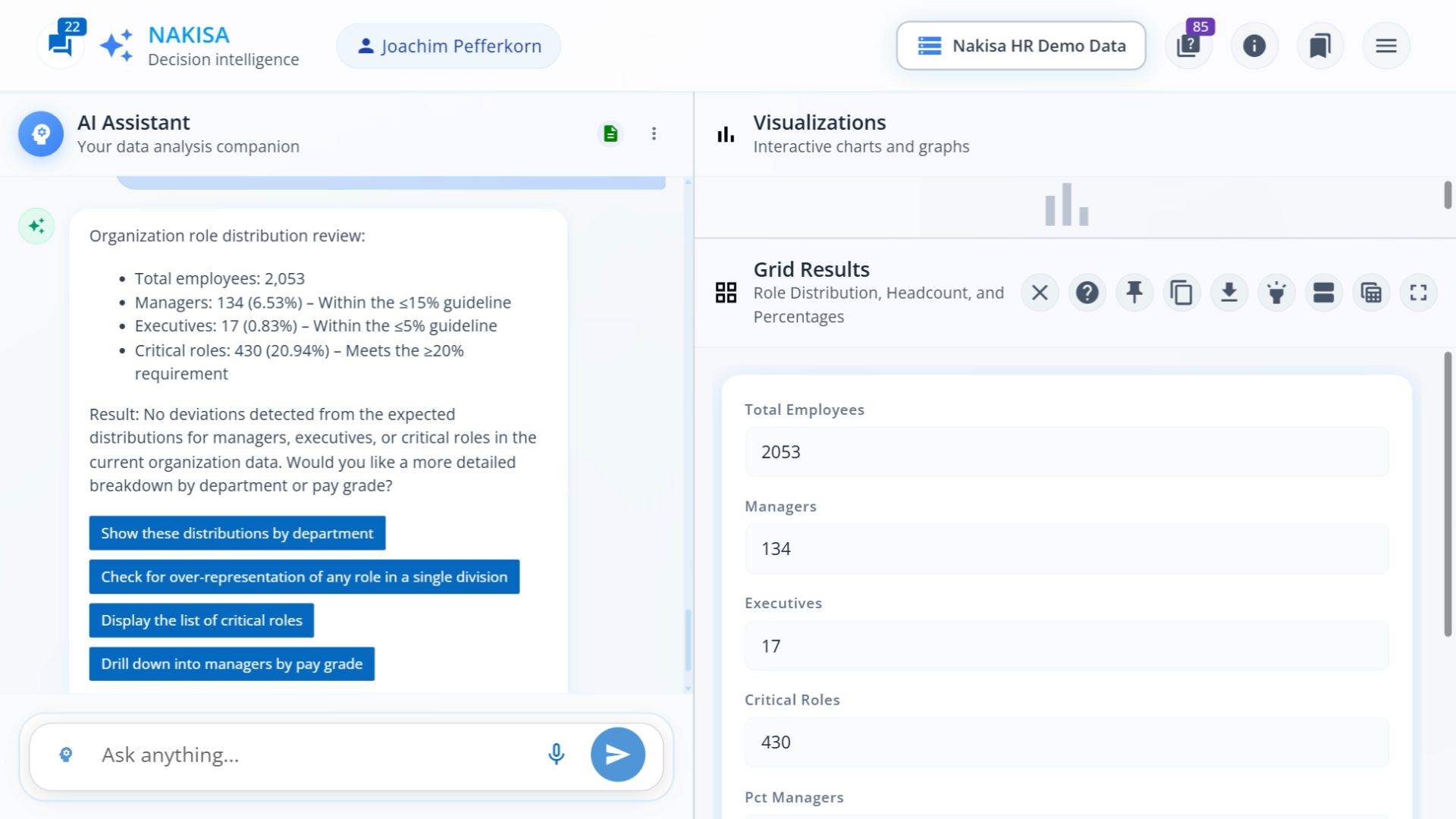
At first glance, this suggests the organization is well balanced. However, averages can hide important nuances.
To go deeper, we drill down into the percentage of critical roles by department to ensure this principle is applied consistently across the organization, not just in aggregate.
Evaluating workforce composition
Prompt: “Show the percentage of critical roles by department.”
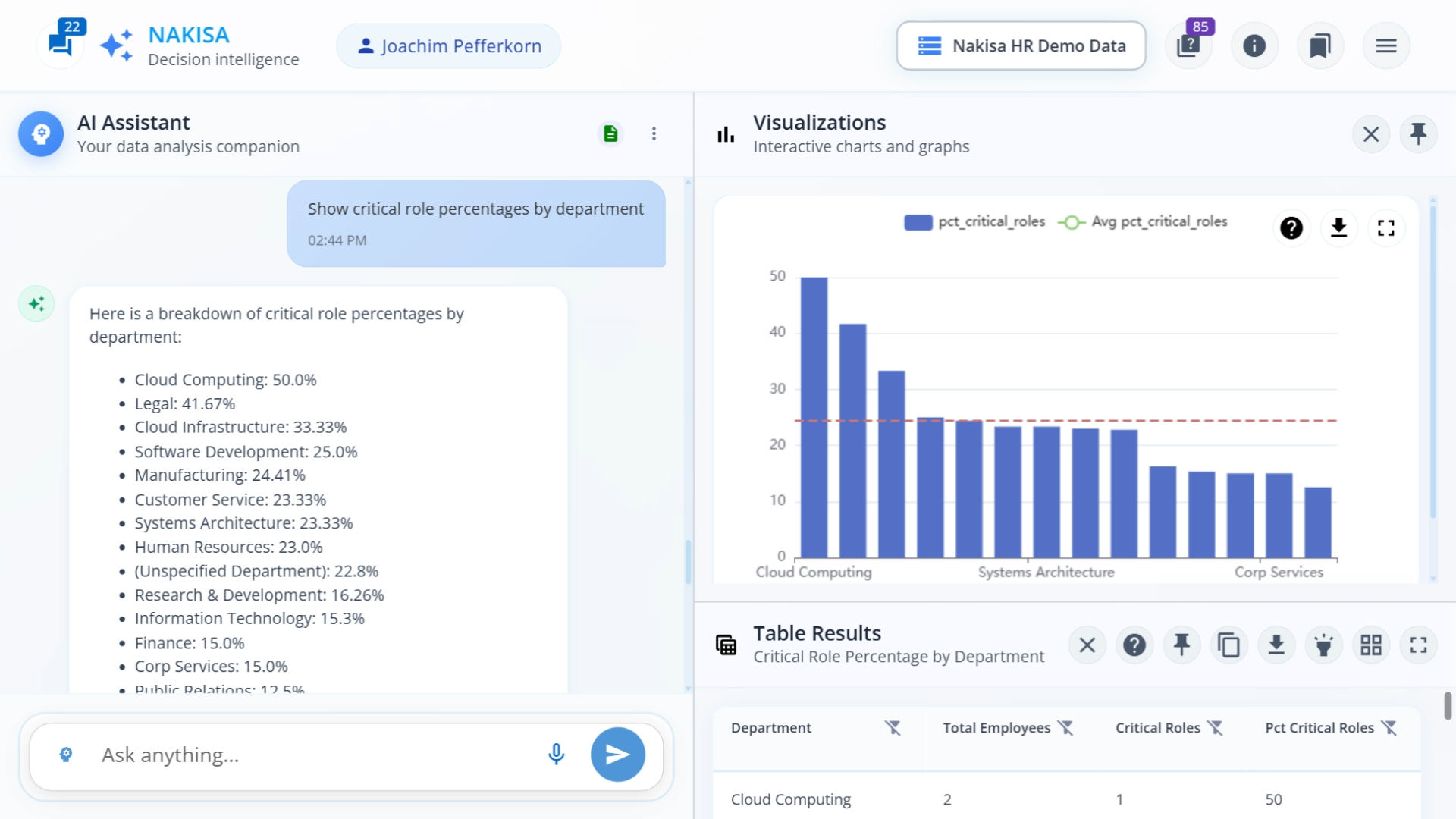
NDI generates a bar chart that breaks down the proportion of critical roles across each department. While the overall average remains within target, certain teams, such as Cloud Computing and Legal, skew significantly higher, while others fall well below the expected range. This imbalance signals the need for closer review, with several positional actions.
For departments with a higher concentration of critical roles, HR teams can:
- Validate whether roles are accurately classified as critical
- Assess concentration risk and succession coverage for key positions
- Identify potential over-reliance on niche or hard-to-replace skills
For departments with a lower concentration of critical roles, HR teams can:
- Evaluate whether future demand and strategic priorities are adequately supported
- Trigger targeted hiring or upskilling initiatives
- Revisit role definitions to ensure critical capabilities aren’t being overlooked
These insights can be easy to miss in a surface-level analysis. With NDI, teams can move from high-level validation to detailed investigation in seconds.
Evaluating workforce cost principles
Thanks to this initial prompt, we’ve quickly validated a key composition principle and gained department-level insights.
Next, we turn to workforce costs by reviewing rule number five, which requires each position’s pay grade to be lower than that of its parent position.
Prompt: “Run a validation check on our fifth organization design principle and report only positions where the pay grade is higher than the parent positions’ pay grade.”
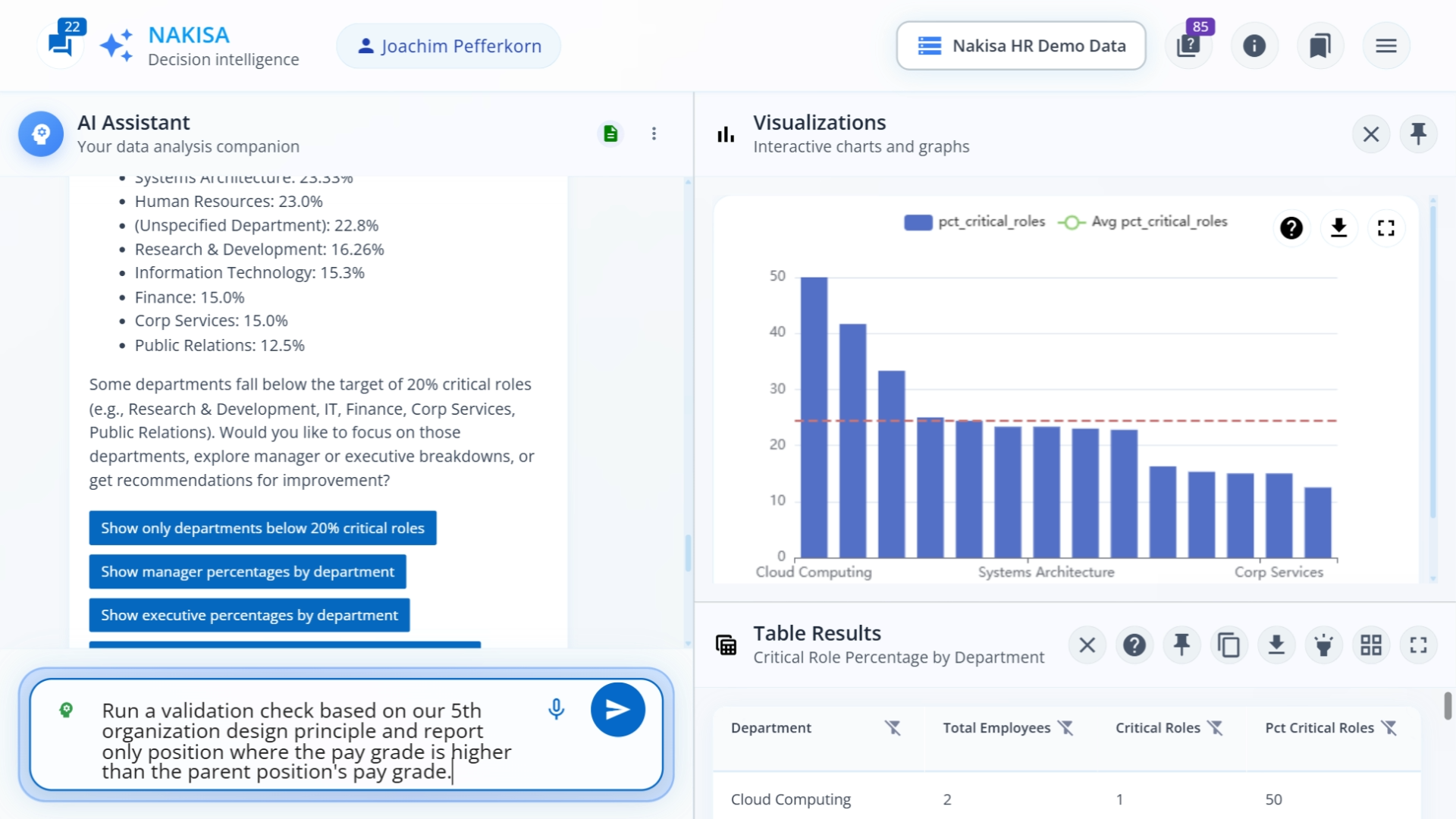
NDI flags any violations and generates a table listing the position ID, name, pay grade, and the corresponding details for the parent position.
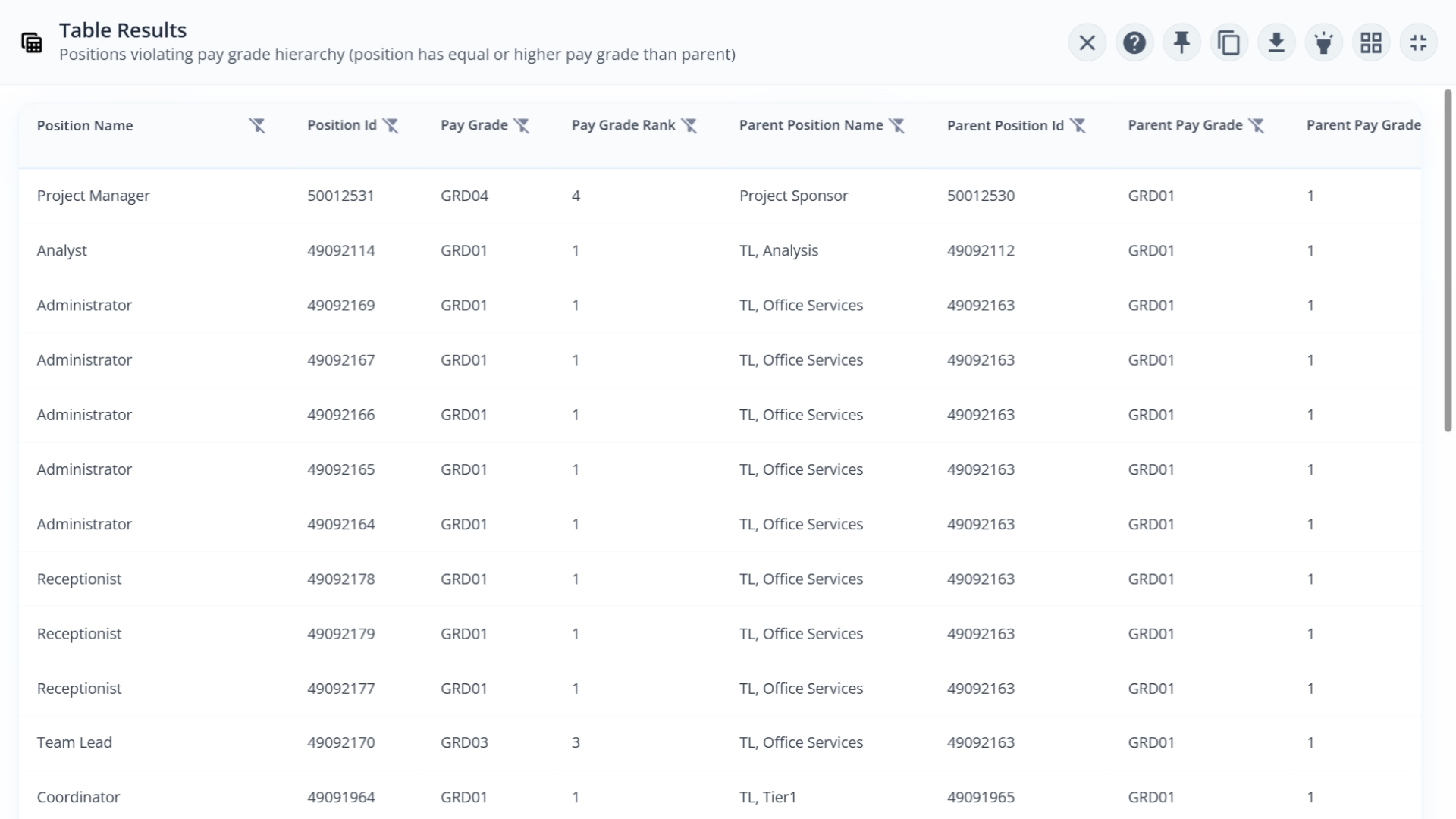
This immediate visibility allows leaders to identify inconsistencies, assess potential compensation risks, and prioritize adjustments where needed. They can review pay grades for accuracy, ensure internal equity across roles, anticipate potential misalignments due to promotions or market changes, and take corrective action.
Our next principle focuses on workforce costs, specifically the gender pay gap. To support DEI initiatives and compliance reporting, we can quickly run a validation check to highlight areas where pay disparities between genders may be too large.
Prompt: “Run a validation check on our sixth organization design principle and report on job families with a gender pay gap greater than 20%.”
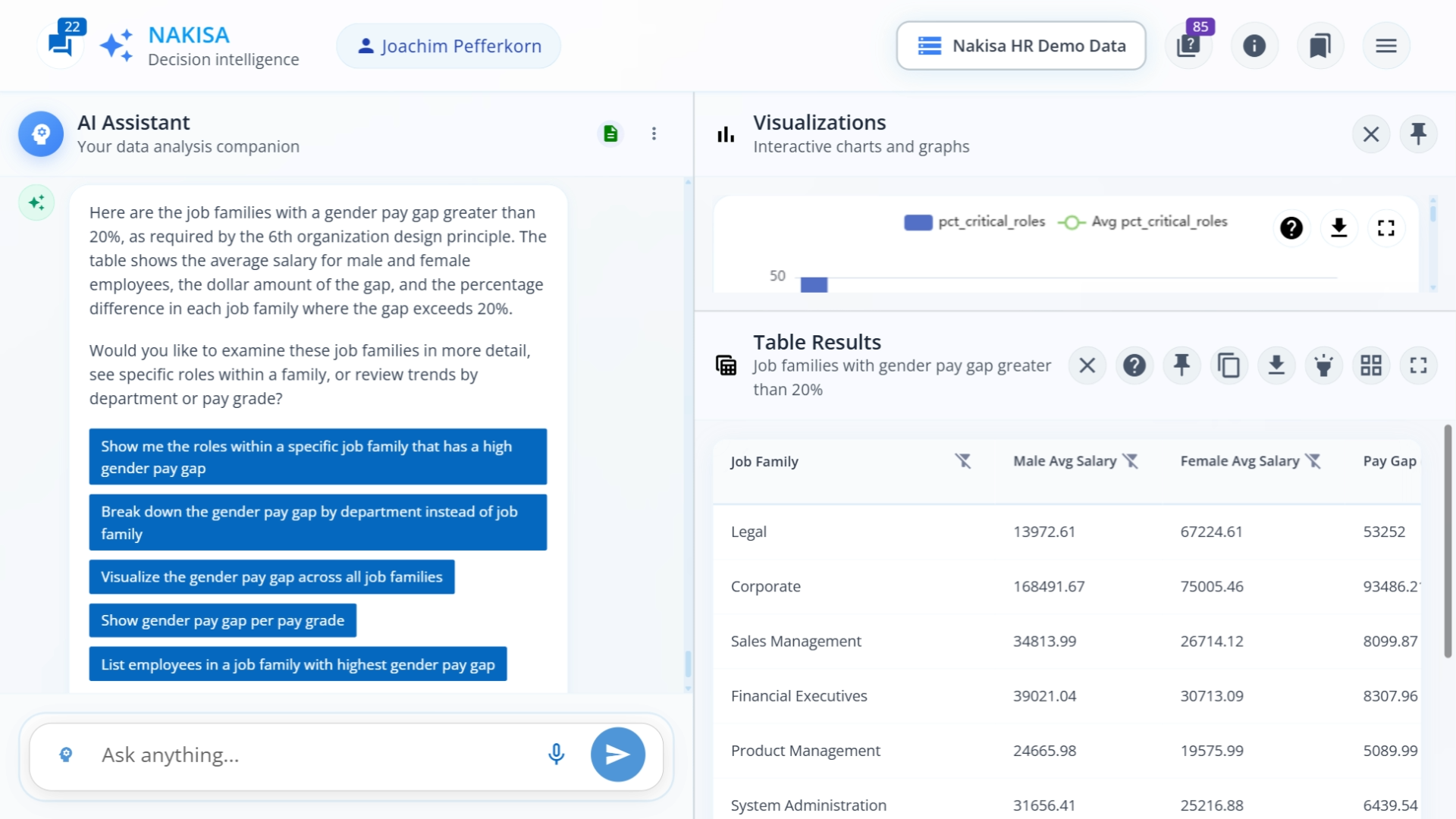
NDI surfaces the job families where pay gaps are largest, presenting them in a clear, detailed table. For example, we can focus on the Product Management department and ask NDI to break down the gap by pay grade. This uncovers patterns or outliers that may explain the imbalance and supports more targeted, informed actions.
Prompt: “For the Product Management department, show a gap analysis broken down per pay grade as well.”
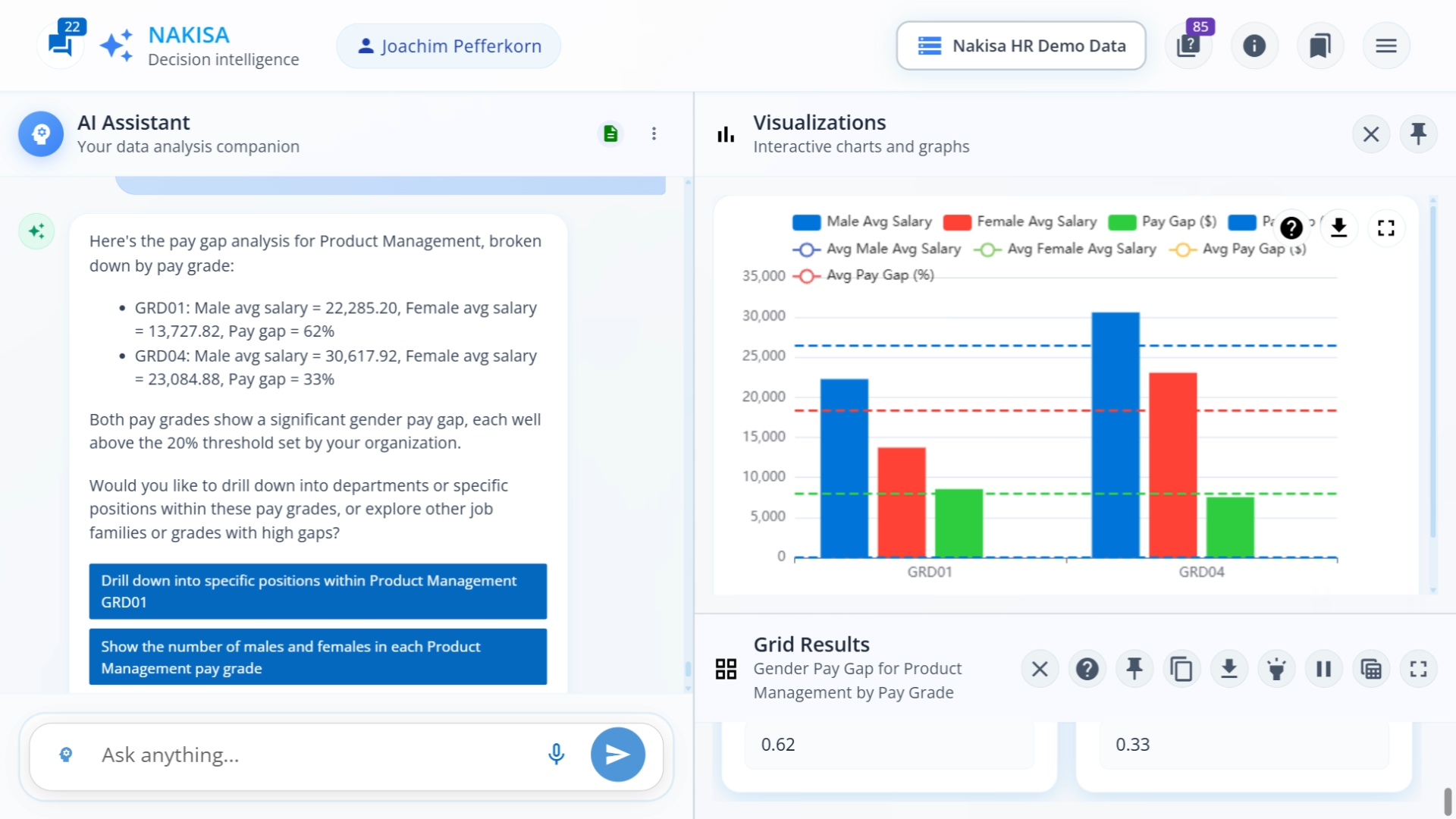
The results reveal that, across several pay grades, the gap exceeds our acceptable limits. Focusing on Grade 01, we can dig deeper by asking NDI to factor in skills, tenure, performance, and potential, providing a more complete picture of what may be driving the imbalance. In this demo, we focus specifically on executive compensation.
Prompt: “For GRD01 in Product Management, show distinct employee salary data alongside skills, tenure, performance, and potential.”
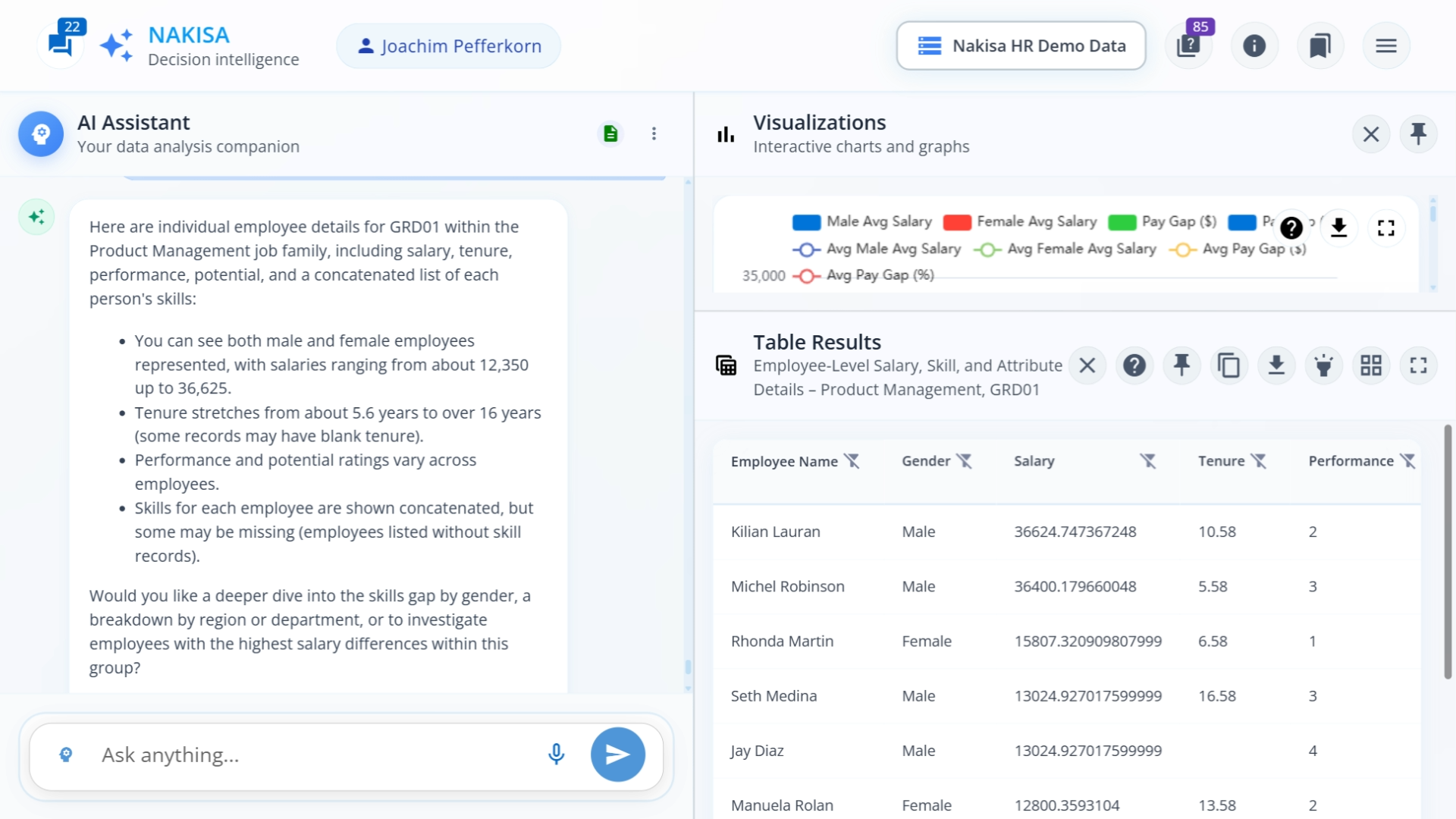
The system generates a detailed chart for executive-level employees, making it easy to compare compensation and assess how it aligns with factors such as skills, tenure, performance, and potential. To deepen the analysis, we can ask NDI to pinpoint drivers behind any disparities, for example, evaluating whether tenure is a key driver.
Prompt: “Let's discuss potential reasons behind the significant salary difference. What insights do you have? Does tenure play an important role in this case?”
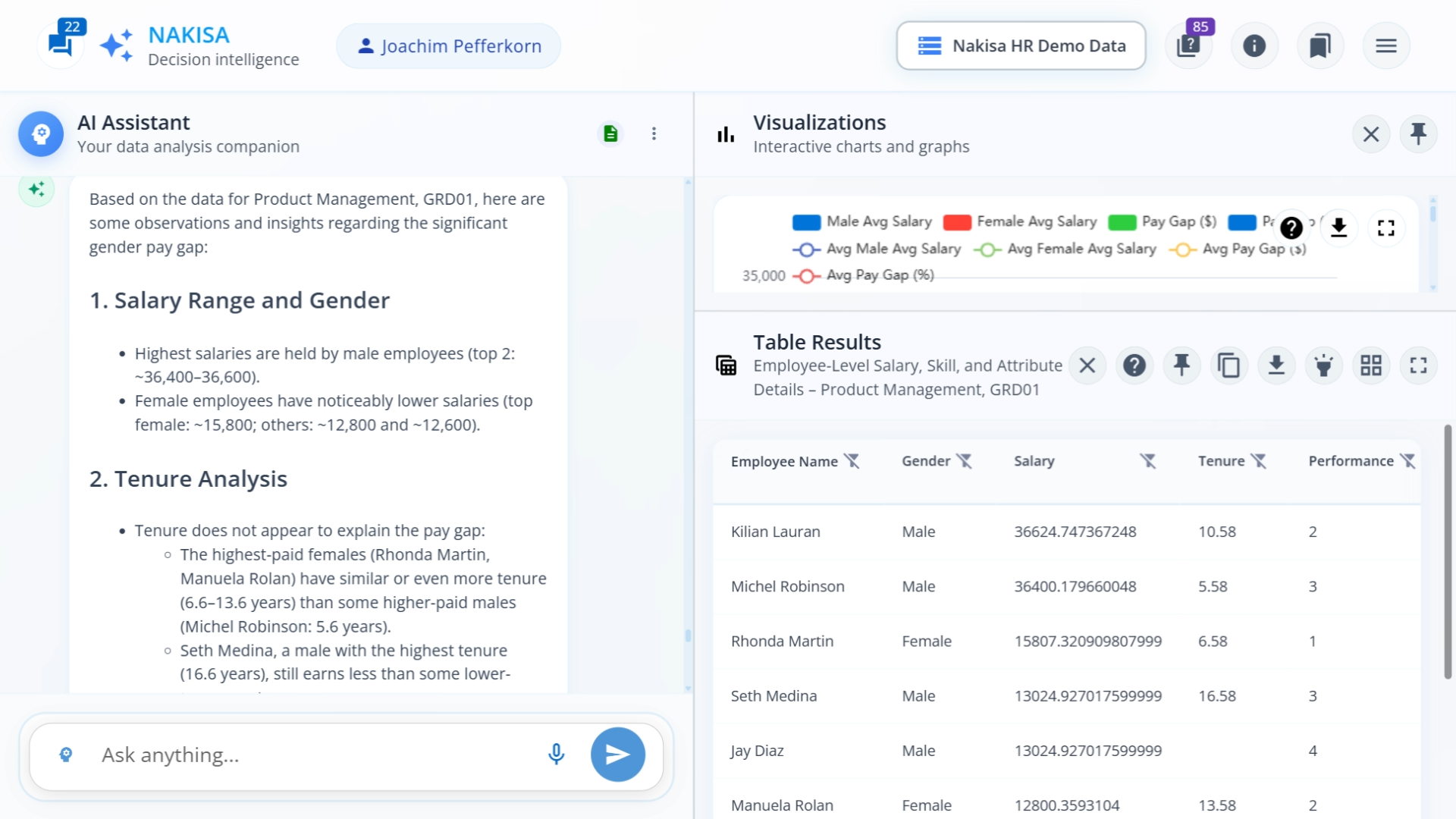
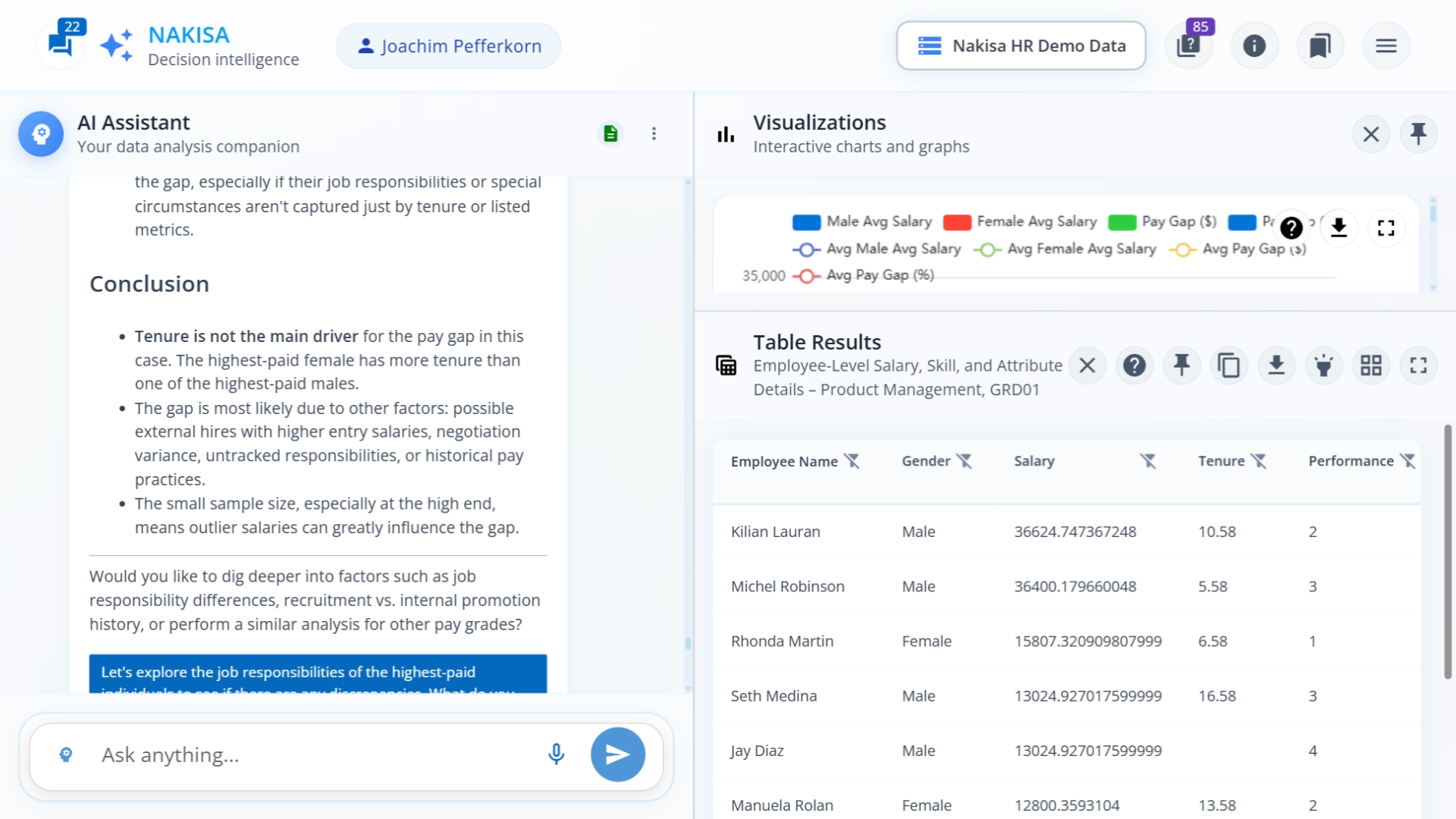
The analysis suggests that the gap is most likely driven by factors such as external hires entering at higher salary levels and differences in negotiation at the start of the role. This highlights the need to review hiring practices and salary band governance, since such inequities can increase the risk of losing key talent.
Since NDI also enables advanced what-if simulations, we can take the next step by prompting it to estimate potential turnover risk associated with this pay gap, giving leaders a clearer view of the potential business impact.
Prompt: “If no action is taken, what is our estimated turnover risk for the impacted group?”
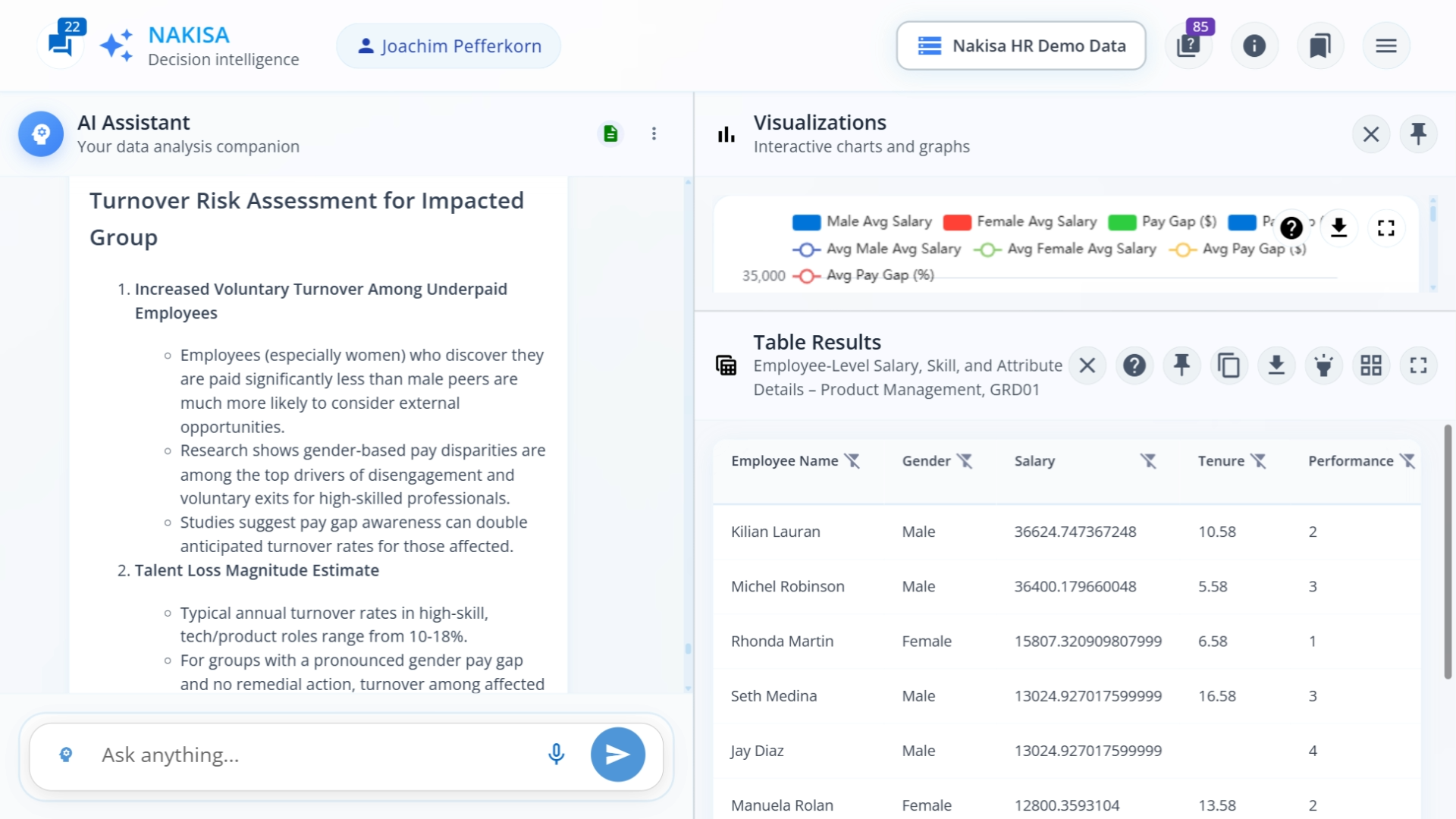
Leveraging external benchmarks and industry averages, the system provides detailed estimates of potential talent loss and voluntary turnover if the pay gap remains unaddressed. The results clearly indicate that corrective action should be treated as a high priority.
Next, we ask NDI to model three scenarios: one focused on bringing the organization into compliance, another aligned with market compensation levels to remain competitive, and a third scenario aimed at supporting long-term internal pay equity correction by addressing structural pay gaps over time.
Prompt: “Model three scenarios. 1) Minimal compliance fix. 2) Market-aligned fix. 3) Long term equity corrections. What are the implications of each?”
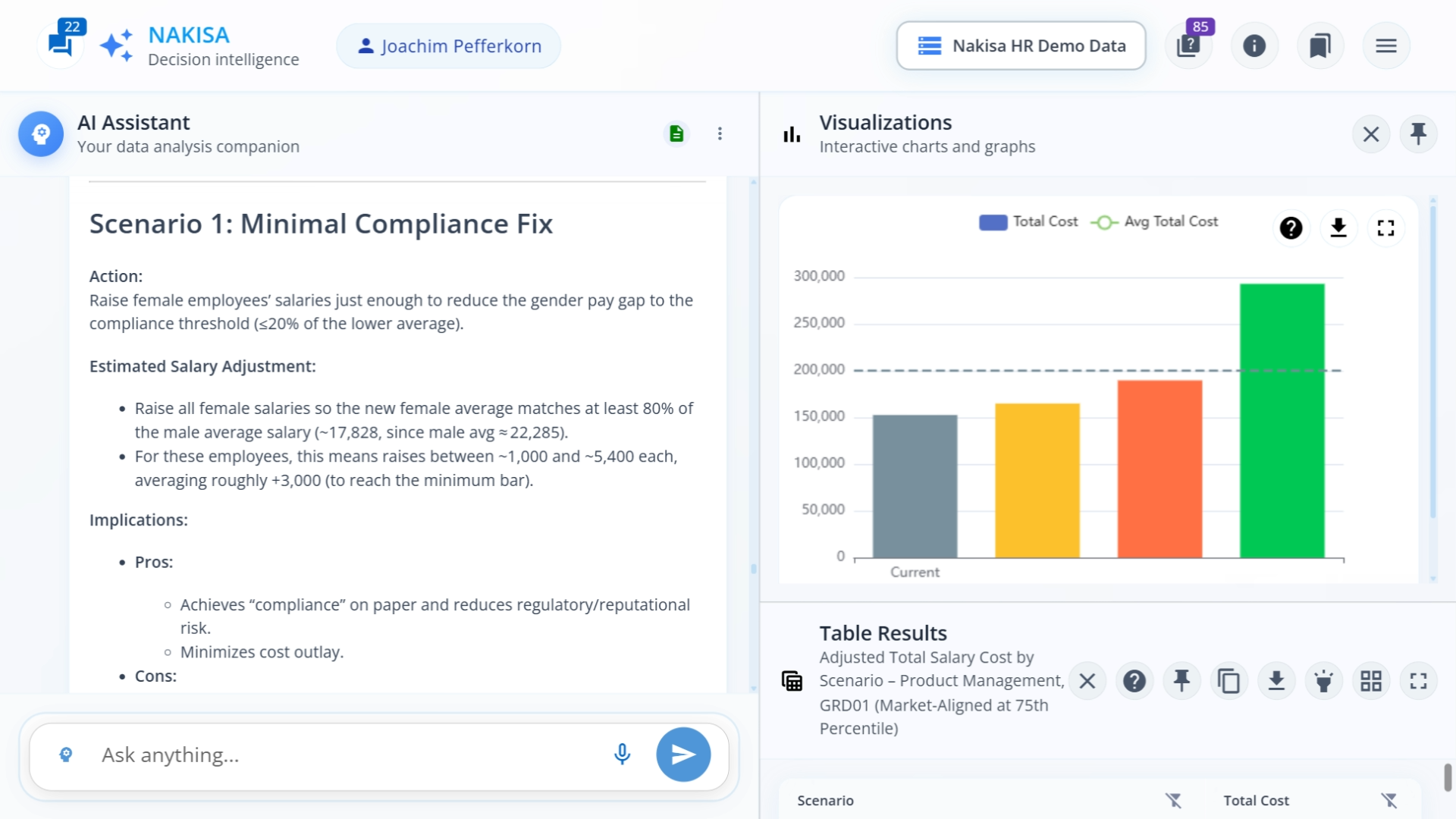
We receive three detailed scenarios, each outlining pros and cons along with estimated costs based on market data and our current workforce. While the long-term equity option offers the best approach to maintaining employee morale and is the most future-proof solution, it also carries the highest cost.
With just a few targeted prompts, we’ve uncovered the factors driving the gender pay gap in this department, assessed the associated risks, and explored multiple action plans to address it. For executive presentations, the insights, including tables and charts, can be exported directly, making it easy to share a clear, data-driven story of the analysis and decisions enabled by NDI.
Evaluating workforce structure
For the final design principle in this demo, we focus on structural health. To begin, we display a chart showing the average span of control for each department, compared against our target ranges to quickly spot areas that may need attention.
Prompt: “Show a chart of the span of control per department, with target ranges.”
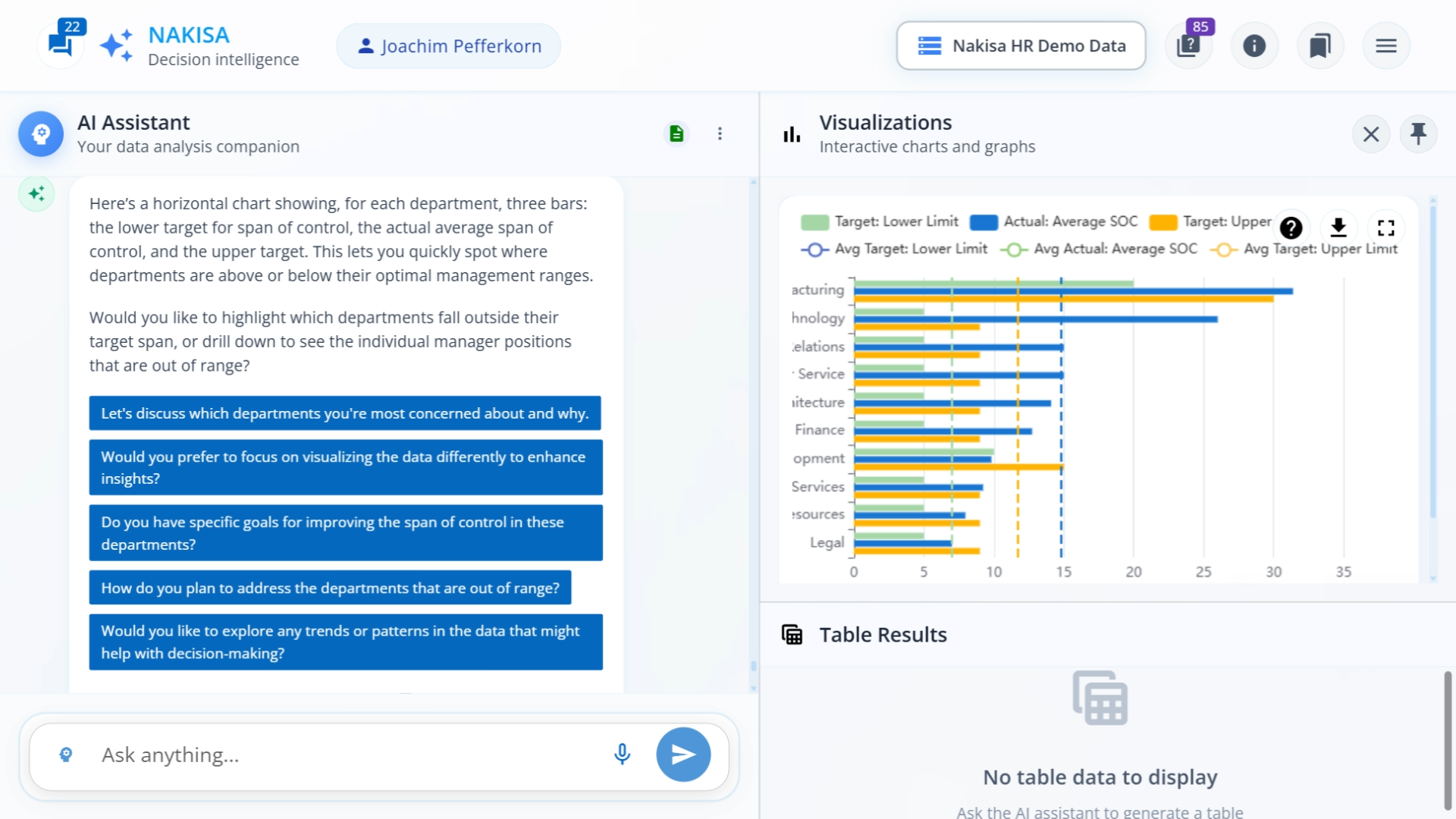
We get a clear chart showing each department’s average span of control alongside the target lower and upper bounds we’ve defined. To zoom in on a specific area, we can prompt NDI for more detail. For instance, we can generate a list of managers in Finance to examine their individual spans of control, uncover bottlenecks or imbalances, and identify targeted organizational design improvements.
Prompt: “List all individual manager positions in Finance with their span of control. Include their targets and create position links.”
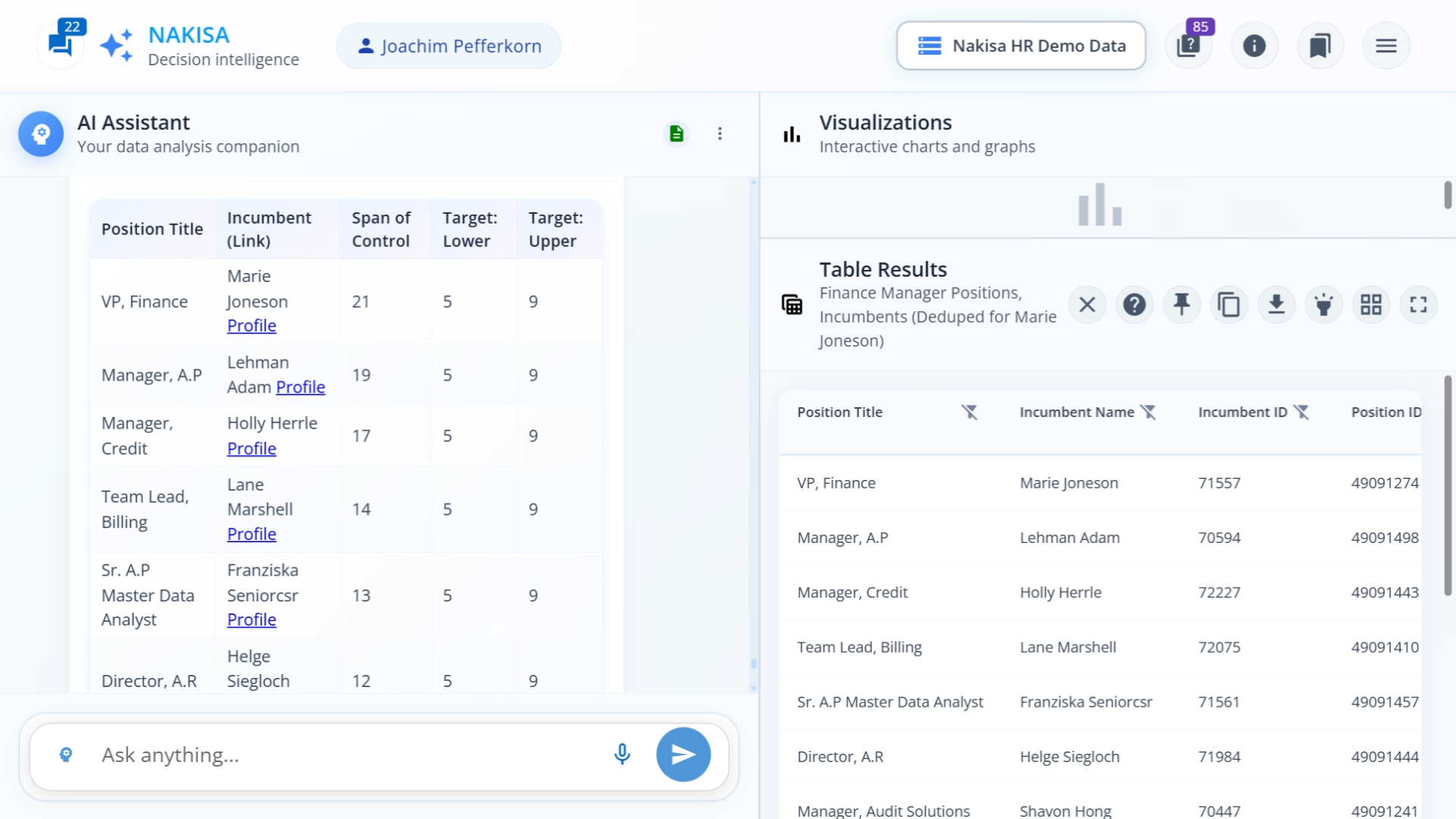
By reviewing the table, we can click on individual incumbents’ profiles, which takes us directly into the Nakisa Org Chart software. In this case, we go to our VP of Finance, who has the highest span of control, to explore potential structural adjustments and better balance their team.
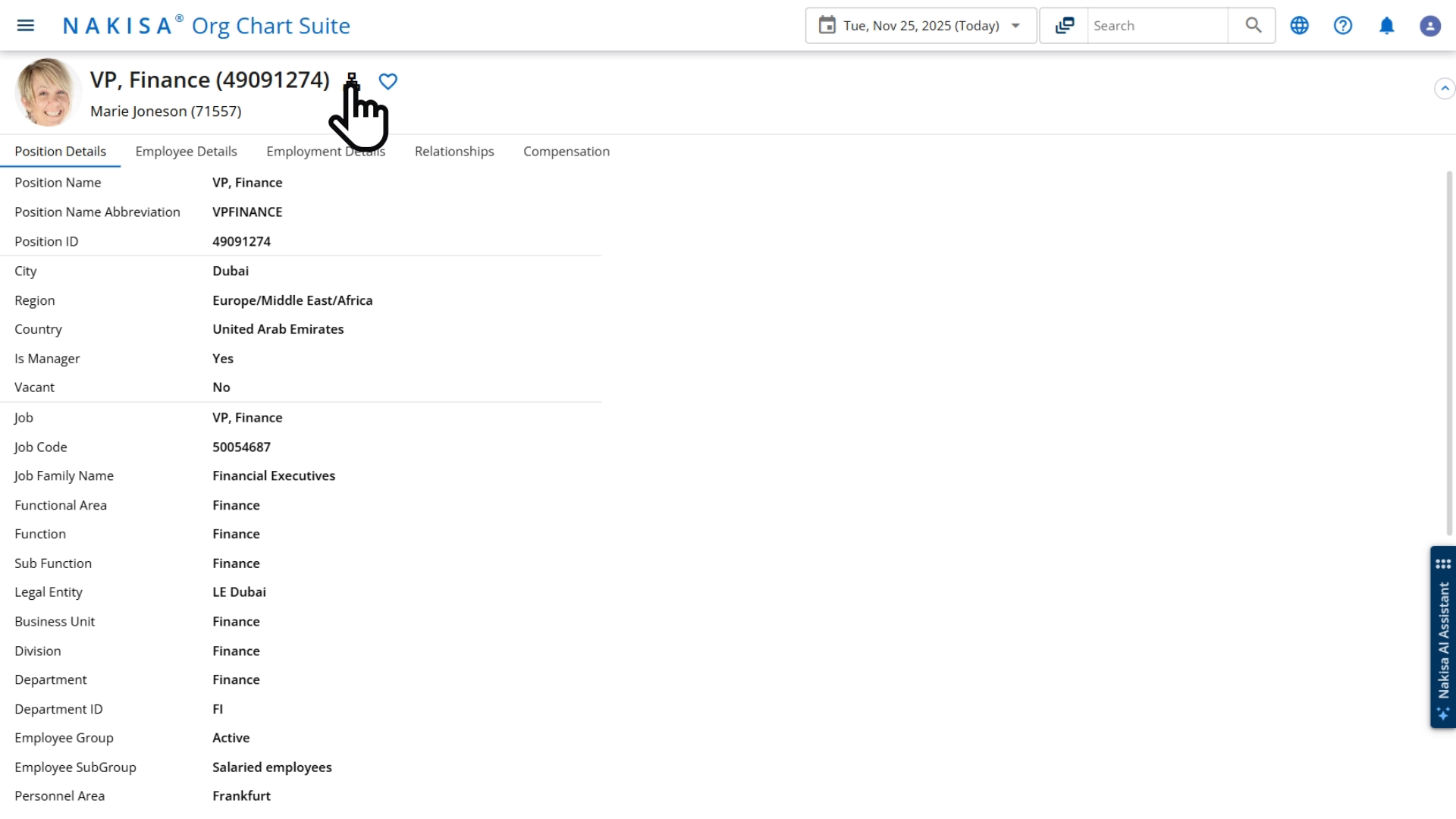
The seamless integration between NDI and other Nakisa products allows us to access our VP's detailed profile in Nakisa Org Chart. From there, we can simply click to view her directly in the org chart, seamlessly switch to “Edit” mode, and create an org design proposal.
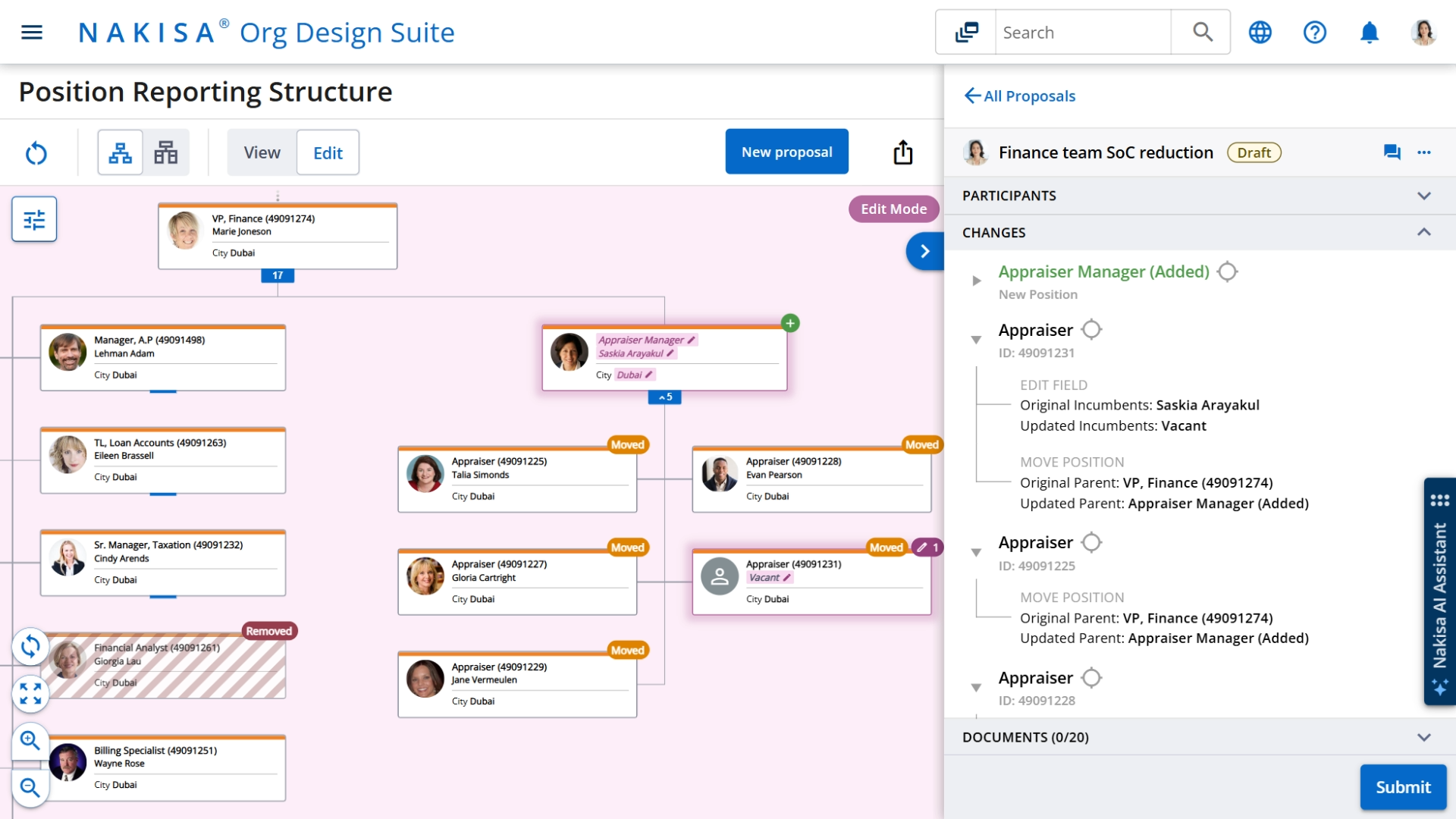
Following this analytical work with NDI, we can move forward with submitting a new proposal to adjust the span of control and bring it within our target ranges.
Conclusion
Through this walkthrough, we’ve seen how validating organization design principles can move from a slow, manual, and sometimes inaccurate exercise to a fast, insight-driven, reliable process. In just minutes, we validated multiple principles across workforce composition, costs, and structure: work that would traditionally take days or weeks of analysis. More importantly, we didn’t just identify issues; we uncovered root causes, quantified risks, modeled solutions, and generated actionable remediation plans.
This is the power of NDI: transforming organizational design from a reactive, periodic exercise into a continuous, data-driven discipline. Whether you're planning workforce growth, optimizing headcount, preparing for a restructure, supporting DEI compliance, or maintaining a healthy workforce balance, NDI gives you the speed, depth, and confidence needed to make informed decisions backed by both enterprise data and external benchmarks and grounded in internal policies and guardrails.
Ready to see what other insights NDI can uncover in your workforce data? Explore our NDI Resource Hub for more information or contact us to schedule a free, in-depth demo with our experts. Nakisa clients can also access a preview environment to see the solution in action.