IBM is ending standard support for TRIRIGA
Migrating to Maximo isn't your only option.
If you’re already investing time, budget, and IT resources in a migration, this may be the best opportunity you’ll have in years to modernize your real estate technology stack.
During a readiness assessment, you’ll get a structured, no-obligation review of your current IBM TRIRIGA environment, priorities, and migration options.
Passed
Jan 28, 2026
IBM software ordering for TRIRIGA ended. Existing customers continue under their current subscriptions and entitlements.
Upcoming
Sep 30, 2027
Standard support ends for TRIRIGA. Paid support options remain available. Customers moving to Maximo can use Dual Support through April 30, 2029.
Next
Apr 2029
Dual Support with MAS ends. Customers using this path must complete their cutover to Maximo Real Estate & Facilities by this date.
WHAT DOES THE TRIRIGA TRANSITION MEAN FOR YOU
TRIRIGA to Maximo: more than a version upgrade
IBM has designated Maximo Real Estate & Facilities as the upgrade path for TRIRIGA. But IBM’s own migration guidance describes work well beyond a conventional version upgrade — which is exactly why this is the moment to evaluate different platforms. With dedicated budget, IT mobilization, integration work, and retraining, the question you should ask is not “how do we upgrade?” — it’s “which platform is the right fit for the next ten years?”
What migration to Maximo means for you:
01
New suite licensing under the AppPoints model
02
MAS deployment and database preparation
03
Database preparation and migration activities
04
User licence migration and re-provisioning
05
End-user retraining and change management
06
Mobilization of significant internal IT and budget resources
Scope items above are drawn from IBM’s published TRIRIGA-to-Maximo upgrade and lifecycle documentation. Confirm current details for your version and contract directly with IBM.
Your options
Three paths you have today
Every path requires investment, resources, and planning. Compare options before committing

01
Stay on TRIRIGA for now
Use IBM’s paid support options to extend your runway before migrating or replacing the platform.
QUESTIONS YOU SHOULD ASK
→What paid support options apply to our version — and what do they cost?
→What security and compliance exposure
builds over time?
→Does delay preserve options, or compress
the eventual migration?
02
Migrate to Maximo Real Estate & Facilities
Follow the incumbent path to IBM’s successor platform.
Questions to ask
→How much of your environment genuinely carries forward?
→What does AppPoints licensing cost at your usage levels?
→Does the target state fix the problems that matter most to you?

03Worth evaluating
Replace TRIRIGA with a purpose-built platform
Compare a platform built for your priorities before you commit.
Questions to ask
→Does it meet your functional scope for real estate and lease?
→How does migration effort and disruption actually compare?
→Does it deliver stronger ERP alignment, predictability, and adoption?
Need help planning your next move?
Use our Migration Guide & Workbook or book an assessment with us. Our experts bring decades of experience helping organizations plan and execute complex transformations.
What you need to consider
Six criteria for evaluating IBM TRIRIGA alternatives
These six criteria help separate a straightforward replacement from a better long-term platform decision. Ask every vendor — including IBM — how they measure up.
01
Migration complexity & long-term vision
Many organizations have invested years in customizing workflows. Evaluate whether a new platform can support your requirements through configuration or requires continued redevelopment
Ask yourself: Can a new platform adapt without adding technical debt?
02
Global compliance capabilities
Evaluate support for IFRS 16, ASC 842, privacy requirements, and local tax and regulatory needs across your footprint.
Ask yourself: Will the platform fit naturally into your technology ecosystem or create additional complexity and manual workarounds?
03
Deployment speed & readiness
Look for a proven migration strategy, configurable workflows, and a clear implementation path that can reduce time to value.
Ask yourself: How quickly can we get to production — and what work, dependencies, and decisions determine that timeline?
04
Operational asset alignment
Connecting physical assets, facility conditions, and lease contracts in one operational model.
Ask yourself: Do you need a full IWMS, or finance-led lease management and real estate portfolio depth?
05
Predictable, clear cost model
Compare the full cost model — licensing, implementation, integrations, infrastructure, administration, upgrades, and ongoing services.
Ask yourself: Can you forecast total cost with confidence, or does the licensing model make future spend hard to predict?
06
End-user adoption rate
Intuitively designed interfaces that reduce training friction and operational errors.
Ask yourself: Will the platform drive user adoption or create extra complexity?
Built for your team
What determines the best-fit platform?
Your ERP strategy, business requirements, and portfolio complexity can have a significant impact on which platform best fits your organization.
Especially critical for:
SAP-CENTRIC ORGANIZATIONS
Why native ERP integration matters
Integration with your tech stack affects everything from financial accuracy to operational efficiency. Consider how real estate, lease, and facility data moves across your technology landscape and whether it remains aligned without manual effort.
Look for:
→Native bidirectional SAP & Oracle integrations — no
middleware to maintain
→Automated postings, cost-center mapping, and
payment schedules stay in sync
→Audit-ready trail across lease events without manual
journal entries
→Built-in ASC 842, IFRS 16, and GASB 87 compliance alongside SAP data
Especially critical for:
RETAIL & Financial Institutions
Why industry fit matters
Organizations managing large networks of stores, branches, offices, or facilities often have requirements that generic workflows cannot easily support. Evaluate whether the platform is designed for the realities of your operating model.
Look for:
→Portfolio-wide visibility across leased, sub-leased,
and owned locations
→For retail: Automated percentage-rent calculations and CAM reconciliation at scale
→Configurable out of the box to minimize rebuilding workflows across different location types and operating models
→Out-of-the-box and ad-hoc reporting for renewals, obligations, and optimization
Especially critical for:
GLOBAL, COMPLEX RE PORTFOLIOS
Why your portfolio size matters?
Managing real estate across regions, business units, and currencies introduces complexity that grows over time. Consider whether the platform can support expansion without increasing administrative overhead.
Look for:
→Multi-region and multi-currency portfolio management
→Cloud-native platform designed for continuous, non-
disruptive upgrades
→ Configurable workflows that minimize reliance on third-party integrators
→Decision-intelligence tooling built for evolving
workplace strategy
A credible candidate
Why enterprises consider Nakisa
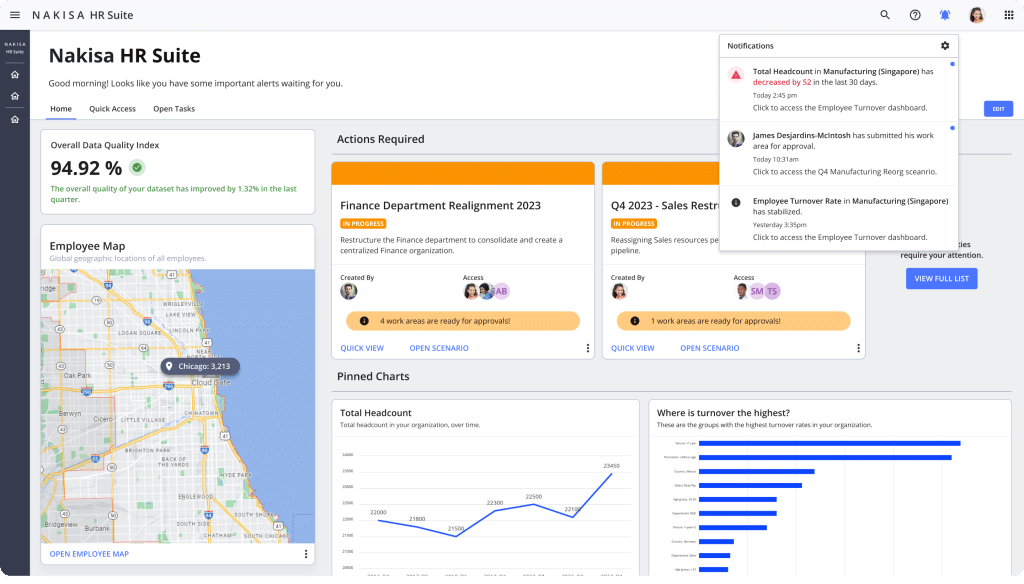
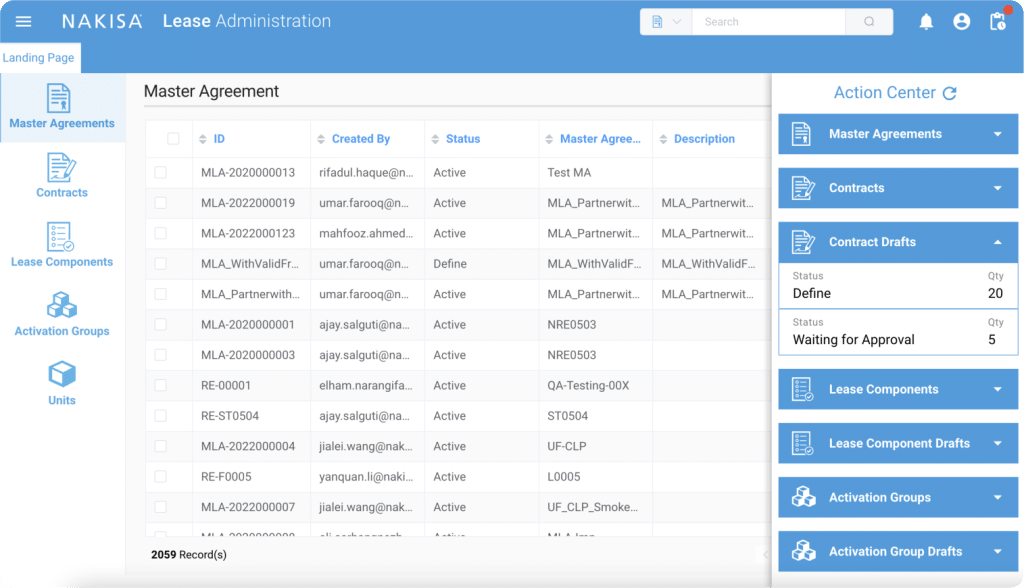
Nakisa belongs on your shortlist when you need real estate operations, lease
administration, lease accounting, and finance connected as one operating model —
particularly in complex, multi-entity SAP environments.
Native, bidirectional SAP integration
Master data, financial schedules, and postings synchronize automatically — no middleware layer to build, maintain, or reconcile.
Real estate and lease accounting in one platform
Portfolio management, lease administration, and ASC 842 / IFRS 16 / GASB 87 compliance in a single system, not stitched-together point
solutions.
Configuration before customization
Meet requirements through configurable workflows instead of bespoke code — so you don’t rebuild a decade of customization debt on a new
platform.
Clear, itemized commercial terms
Migration scope, professional services, and recurring platform costs priced transparently, so finance can forecast total cost of ownership.


Once we went live and got used to the system, it became very easy to integrate with our two SAPs and do SAP postings. Nakisa is very professional in handling two SAPs at the same time, and it gives us flexibility to change the platform easily.
LYN KOK
Project Lead, NTUC Fairprice

Nakisa is excellent software allowing us to be more efficient with all our rent payments, to do better follow-ups on our deadlines, renewals, deposits, etc. The software is very user-friendly. In short, it is essential for our real estate department.
ERIC CABANA
Senior Real Estate Advisor, TC Transcontinental
Primary resource
TRIRIGA Migration: questions to ask before you commit
Map what actually has to move — and what that reveals about your real options.
→Data, customizations, and workflow dependencies to audit first
→ERP touchpoints that need migration or redesign
→Reporting and controls gaps to close before cutover
→Full-cost comparison worksheet across all three paths
→The questions to put to every vendor — including IBM
Get the TRIRIGA Migration Decision Guide and Migration Assessment Workbook
Instant access — no sales call required.
Not ready for the guides? Talk to us directly about your specific TRIRIGA environment.
QUESTIONS & ANSWERS
Direct answers to what TRIRIGA customers research before choosing a path.
IBM TRIRIGA end of support and migration: FAQ
When does IBM TRIRIGA support end?
IBM has published an end-of-support date of September 30, 2027 for TRIRIGA and the TRIRIGA
Application Suite, across all versions — no version is exempt. Software sales closed on January
28, 2026. Customers who remain on TRIRIGA after September 2027 can move into IBM Sustained
Support for a period; customers who migrate receive Dual Support with the Maximo Application
Suite for up to 19 months but must fully cut over to Maximo Real Estate & Facilities by April 2029
to retain that overlap. Confirm current lifecycle dates for your version against IBM’s official
support documentation.
Is moving from TRIRIGA to Maximo a standard upgrade?
Not for most customers. Maximo Real Estate & Facilities is TRIRIGA re-platformed onto the Maximo Application Suite. IBM’s own migration guidance references suite licensing under the AppPoints model, MAS deployment, database preparation, Red Hat OpenShift infrastructure, persistent storage migration, user licence migration, application migration, testing, and workflow review. The underlying database can carry forward, but custom workflows and integrations generally need to be rebuilt. For most organizations this is closer to a re-platforming programme than a version upgrade — which is why it warrants a full evaluation rather than an automatic decision.
Is Maximo the only replacement option for TRIRIGA?
No. Maximo Real Estate & Facilities is IBM’s successor path, but it is one option among several. Where organizations are replacing the full IWMS suite, vendors such as Planon, Eptura, MRI Software, Tango, Nuvolo, and Spacewell are commonly shortlisted. Where the scope is real estate and lease — including lease accounting — MRI Software, Yardi, Nakisa, and Accruent appear most often. Because a migration requires investment either way, comparing the incumbent path against at least one credible alternative is ordinary due diligence.
When should we start evaluating TRIRIGA alternatives?
The evaluation window is already open. Through 2026, customers are formally analyzing options — issuing RFIs and RFPs, securing budget, and building business cases. Vendor selection and shortlist finalization are expected to concentrate from late 2026 into early 2027, with implementations running through to the September 2027 deadline. Full IWMS replacement cycles typically run at least three to four months from evaluation to selection, before implementation begins. Starting earlier preserves the most options and the most negotiating leverage.
What should SAP customers consider in a TRIRIGA migration?
Where SAP S/4HANA or SAP ECC is the system of record, ERP integration should be a major selection criterion — especially for finance-led lease accounting projects.The decisive question is not whether a platform can technically connect to SAP, but how much manual reconciliation, duplicate entry, middleware dependency, and month-end close effort remains afterward. Weak ERP integration produces recurring operational pain: duplicate data entry, reconciliation issues, and manual journal postings. Evaluate native, bidirectional integration against middleware-based approaches, and ask each vendor to quantify the close-cycle effort their platform removes.
How should heavily customized TRIRIGA environments be assessed?
Long-standing TRIRIGA environments can contain substantial customization across organizational structures, roles and permissions, approval logic, asset libraries, data structures, and reporting.That increases migration complexity regardless of destination. Use the transition to classify each customization as migrate, retire, or redesign, then evaluate whether a configuration-first platform can meet the surviving requirements without rebuilding the debt.
How does IBM's AppPoints licensing model work, and why does it matter?
Maximo Application Suite uses AppPoints as a licensing unit across applications, user entitlements, and some installs. Because the model works differently from simple per-user licensing, organizations should model expected AppPoints requirements against actual users and use cases before committing.
For budgeting and commercial governance, compare the resulting economics with alternative licensing models and confirm current licensing terms directly with IBM.
What belongs in a TRIRIGA migration business case?
A defensible business case covers the full cost and effort of each path — not just licence or subscription fees — the data and customizations to migrate or retire, ERP and SAP integration impact, reporting and controls gaps, implementation and partner risk, user adoption, and expected future value including AI and automation. It should state clearly why the selected platform is the best fit for your future, not simply the most familiar option. The test: does the decision hold up under board, finance, procurement, and audit scrutiny?
Why should we evaluate Nakisa as a TRIRIGA alternative?
Nakisa is worth evaluating when you need real estate operations, lease administration, lease accounting, and finance connected in one operating model — especially in complex, multi-entity, multi-ERP SAP environments. Areas to assess: native bidirectional SAP integration without middleware; combined real estate portfolio management and ASC 842 / IFRS 16 / GASB 87 compliance; a configuration-first approach that reduces customization debt; clear itemized commercial terms; and modern reporting and decision intelligence. The goal isn’t to assume Nakisa is the answer — it’s to compare it fairly against the incumbent path.
IBM, TRIRIGA, Maximo, and related IBM product names are trademarks of International Business Machines Corporation. Nakisa is not affiliated with, sponsored by, or endorsed by IBM. IBM product, lifecycle, support, and licensing information may change; confirm current details applicable to your environment directly with IBM.