

Explore videos, use cases, guides, and best practices to unlock the full value of Nakisa Decision Intelligence (NDI)

The Nakisa Decision Intelligence (NDI) Platform transforms siloed, static financial data into instant, tailored, context-aware recommendations, executed with Nakisa AI agents.

Introducing Nakisa Decision Intelligence (NDI)

NDI is an enterprise-grade, agentic AI platform that transforms the most complex, scattered data into real-time strategic decisions that can be executed instantly, all through simple text or voice commands.

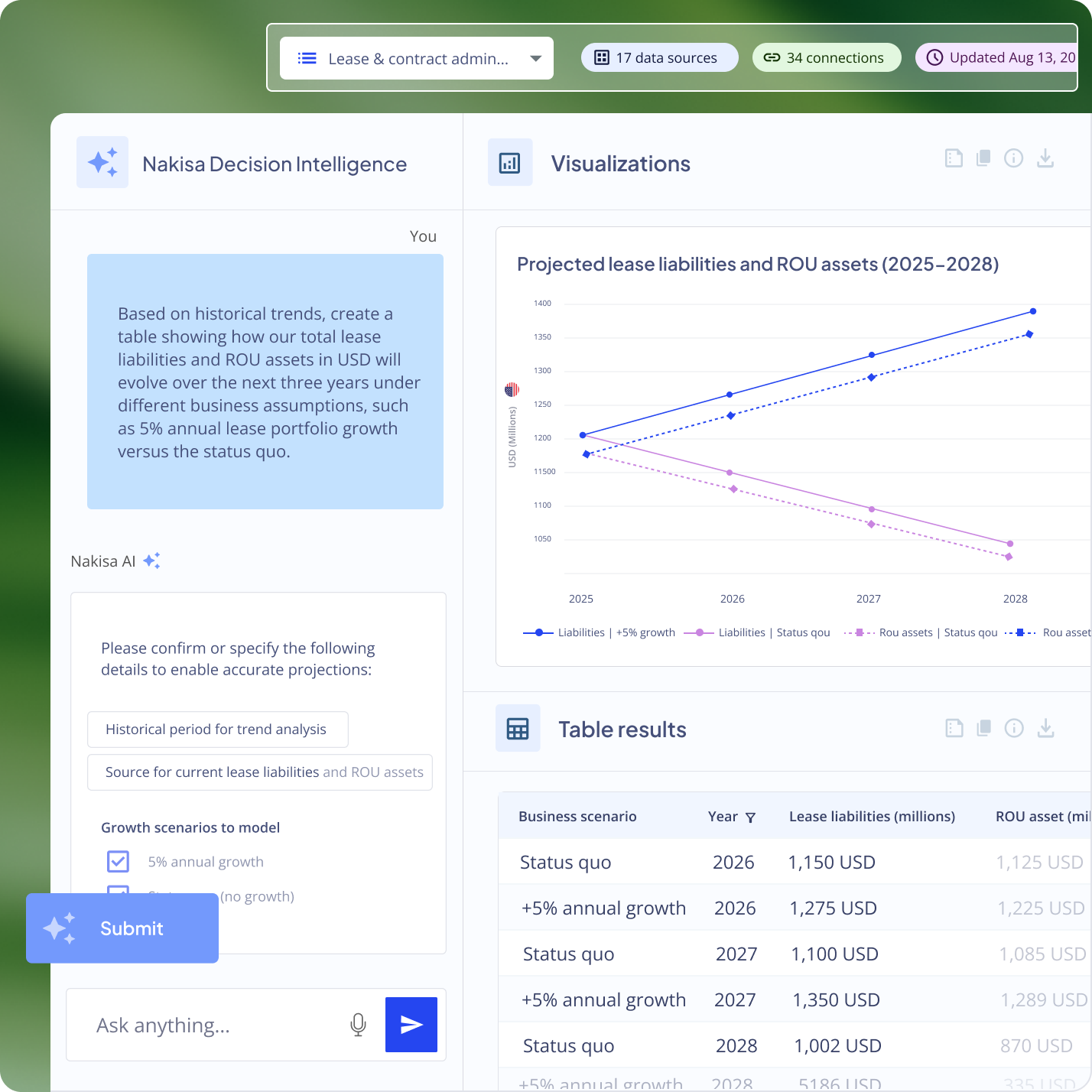
Available as a standalone solution or embedded across Nakisa products, NDI unifies, interprets, and analyzes vast internal and external datasets across any system in real time, running forecasts, simulations, and visualizations.

It goes beyond analysis by not just explaining what happened, but uncovering root causes and delivering clear, prioritized next actions. You can also execute decisions instantly using Nakisa AI agents and apply them directly across your ERP and HCM systems.

The Nakisa Decision Intelligence (NDI) Platform transforms siloed, static financial data into instant, tailored, context-aware recommendations, executed with Nakisa AI agents.

Gain clarity, confidence, and speed with Nakisa Decision Intelligence

0 %

Enhanced decision accuracy

0 %

Reduced time-to-decision

0 x

Faster Analytics

Not using Nakisa Decision Intelligence?

Get started with Nakisa Decision Intelligence

Watch the short videos below to quickly get started with Nakisa Decision Intelligence.

Introduction to Nakisa Decision Intelligence (NDI)

A high-level overview of NDI, what it is, who it’s for, and how it empowers enterprise decision-making.

Navigating the NDI Interface

A walkthrough of the user interface, menus, dashboards, and key navigation patterns.

1. How to navigate and use NDI

Get a guided introduction to NDI, learn how to navigate the interface, use predefined questions and chat instructions, ask questions, and understand how conversations, datasets, and results are organized.

2. How to analyze and visualize data in NDI

Learn how to explore data by creating and customizing charts and tables, applying filters and comparisons, and interacting with visualizations to uncover patterns and trends.

3. How to turn data into decision-ready plans in NDI

Learn how to identify gaps and risks, run scenarios, and generate defensible, data-driven recommendations using analytical, visual, and geographic insights.

1. How to navigate and use NDI
Get a guided introduction to NDI, learn how to navigate the interface, use predefined questions and chat instructions, ask questions, and understand how conversations, datasets, and results are organized.
2. How to analyze and visualize data in NDI
Learn how to explore data by creating and customizing charts and tables, applying filters and comparisons, and interacting with visualizations to uncover patterns and trends.
3. How to turn data into decision-ready plans in NDI
Learn how to identify gaps and risks, run scenarios, and generate defensible, data-driven recommendations using analytical, visual, and geographic insights.

Learn from real-world use cases

See how different teams leverage Nakisa Decision Intelligence for faster, data-driven decisions.

Finance & accounting

You can use NDI to strengthen lease accounting, financial forecasting, FP&A, risk management, and compliance, enabling better financial decisions and sustained long-term performance. Some key use cases include:

1- Lease accounting & compliance

Lease accounting and compliance

Manage complex lease changes, remeasurements, and reporting while ensuring compliance with IFRS 16, ASC 842, and local GAAP across all leases.

Copy prompt:

Analyze lease portfolio for complex modifications, remeasurements, and reporting requirements under IFRS 16, ASC 842, and local GAAP and identify gaps.

Text Copied!

End of term management

Manage lease expirations, renewals, terminations, and related financial and operational obligations to avoid risk and missed actions.

Copy prompt:

Given upcoming expirations, options, and constraints, what actions should be taken, and when to minimize cost and risk while preserving flexibility?

Text Copied!

Periodic reconciliations

Reconcile lease, subledger, and financial data to ensure ongoing accuracy, consistency, and compliance.

Copy prompt:

Identify discrepancies across lease data, obligations, payments, subledgers, and financial systems. Simulate correction scenarios and recommend the best.

Text Copied!

Audit readiness and documentation tracking

Maintain complete, traceable lease and financial records to support internal controls and external audits.

Copy prompt:

How can lease data, calculations, approvals, and supporting documents be continuously organized and validated to support audit readiness at any time?

Text Copied!

2- Reporting & disclosures

Financial reporting and disclosures

Generate accurate, audit-ready lease accounting reports and disclosures by validating data quality, assumptions, and calculations across the portfolio.

Copy prompt:

Consolidate financial data across entities and regions. Deliver audit-ready reports and surface data quality and compliance gaps.

Text Copied!

Regulatory reporting support

Produce compliant regulatory and statutory reports across jurisdictions by aligning lease data, accounting policies, and reporting requirements.

Copy prompt:

How can local and international reporting requirements be met consistently while minimizing risk and manual effort?

Text Copied!

Multi-entity consolidation

Consolidate lease and financial data across entities, regions, and portfolios while detecting data inconsistencies and ensuring integrity for group-level reporting.

Copy prompt:

Identify inter-entity discrepancies, test consolidation assumptions, and recommend optimal, auditable consolidated view.

Text Copied!

3- Financial planning & forecasting

Financial forecasting and scenario modeling

Project revenues, costs, and lease accounting impacts, including cash flows and liabilities, across scenarios to assess outcomes and trade-offs.

Copy prompt:

Project revenues, costs, and lease accounting impacts, including cash flows, liabilities, and remeasurements.

Text Copied!

FP&A-specific scenario analysis

Align forecasts with business targets and test alternative financial strategies and assumptions.

Copy prompt:

Align financial forecasts with targets, test scenarios, assess trade-offs, and recommend optimal financial strategies.

Text Copied!

Cost optimization and variance analysis

Identify cost drivers, explain variances, and surface opportunities to improve financial performance.

Copy prompt:

Analyze costs and budget performance. Identify variances and inefficiencies. Quantify impact and assess root causes.

Text Copied!

Lease vs. buy scenario analysis

Compare leasing and purchasing options to evaluate cost, risk, and long-term financial impact.

Copy prompt:

Compare leasing and purchasing scenarios over time. Test assumptions, assess uncertainty and trade-offs, and recommend the best option.

Text Copied!

Scenario-based risk assessment

Model financial risks and stress-test plans to assess resilience under different scenarios.

Copy prompt:

Model financial risk scenarios and stress-test the portfolio against adverse conditions over time. Recommend prioritized mitigation actions

Text Copied!

4- Capital & investment management

Capital investments and budgeting

Plan, monitor, and adjust capital allocation across projects and properties to stay aligned with budgets and priorities.

Copy prompt:

Plan and monitor capital allocation across projects and properties over time. Evaluate alternative investment scenarios and recommend actions to optimize capital deployment and financial outcomes.

Text Copied!

Capital planning and investment

Evaluate project ROI, compare investment scenarios, and optimize capital spend over time.

Copy prompt:

Evaluate capital investment options by assessing risk-adjusted ROI, strategic value, and timing over time. Compare scenarios and recommend a prioritized, time-phased plan.

Text Copied!

Integrated vendor and contract financial insights

Analyze contract terms, obligations, payments, and vendor performance to control costs and reduce financial risk.

Copy prompt:

Analyze vendor contracts, obligations vs. payments, spend trends, and performance over time. Identify cost leakage, financial risk, and dependency concentration and recommend prioritized actions.

Text Copied!

Project prioritization and ROI analysis

Rank capital initiatives by financial impact, risk, and strategic value to guide investment decisions.

Copy prompt:

Rank projects and initiatives based on financial impact, risk-adjusted ROI, strategic alignment, and resource constraints. Compare funding and sequencing scenarios.

Text Copied!

See Nakisa Decision Intelligence at work. Watch these videos for real examples.

How to analyze lease portfolios, risks, and future scenarios

Gain clear visibility into your lease portfolio, costs, risks, and future scenarios to guide smarter capital and lease decisions.

How to analyze and manage critical dates

Identify compliance risks from missed or upcoming critical deadlines, analyze trends over time, and trigger automated alerts to reduce exposure.

This is not a wrapper; we have tried many AI systems, and no one is close to Nakisa. The major benefit, is that NDI has and knows our data. Other AI systems won’t have that access. NDI doesn’t hallucinate and is made for our use case. This has our data and is enterprise-grade.

— VP, Systems and Policies, Manufacturing Leader with 50K employees

Blogs

Access educational content designed to help you unlock the full power of Nakisa Decision Intelligence.

In this post from our new series, our CTO, Faraz, explains how Nakisa Decision Intelligence (NDI) turns instructions into intelligent decisions using our guiding principles, called chat instructions, making the difference between a useful answer and a transformative one.
In this post from our new series, our CTO, Faraz, explains how Nakisa Decision Intelligence (NDI) interprets intent and adapts to user behavior by balancing analytical precision with creative flexibility through Context Memory and Instruction Strictness.
Explore the limits of traditional lease accounting tools and see how Nakisa Decision Intelligence (NDI) empowers finance and accounting leaders with AI-driven analyses, forecasts, simulations, real-time visualizations, and expert recommendations. It helps teams make faster, smarter decisions and unlock strategic value across large enterprise lease portfolios.
Intelligent decisions with ‘instructions’: how to drive smarter decisions using agentic AI
In this post from our new series, our CTO, Faraz, explains how Nakisa Decision Intelligence (NDI) turns instructions into intelligent decisions using…
How to balance precision and flexibility in decision intelligence platforms
In this post from our new series, our CTO, Faraz, explains how Nakisa Decision Intelligence (NDI) interprets intent and adapts to user…
How Generative AI enables dynamic UI generation in Nakisa Decision Intelligence
In this post of our new series, our CTO, Faraz, explores how generative AI powers dynamic UI generation. Learn how adaptive interfaces…
Introducing Nakisa Decision Intelligence Platform for smarter lease accounting  
Explore the limits of traditional lease accounting tools and see how Nakisa Decision Intelligence (NDI) empowers finance and accounting leaders with AI-driven…
From hallucination to precision: how advanced large language models deliver enterprise-ready Insights
In this post from our new series, our CTO, Faraz, explains how the Nakisa Decision Intelligence (NDI) Platform combines LLM intuition with…

See why market leaders trust NDI

This is not a wrapper; we have tried many AI systems, and no one is close to Nakisa. The major benefit, is that NDI has and knows our data. Other AI systems won’t have that access. NDI doesn’t hallucinate and is made for our use case. This has our data and is enterprise-grade.

VP, Systems and Policies,
Manufacturing Leader with 50K employees

Nakisa’s decision intelligence solution is the most advanced I have seen so far, most competitors only talk about AI without being able to show anything.

Managing Director and RE Tech Leader,
Global Services Company with 400K employees

We have our own AI, but it is nowhere close to Nakisa, because it has and knows our HR-specific data. This is much more reliable compared to even our own AI system that we are developing. Other players in the market don’t have anything like this!


Director, ERP Solutions,
Global Health and Science Company with 95K employees

FAQs

What is the Nakisa Decision Intelligence (NDI) Platform?

NDI is an agentic, enterprise-grade decision intelligence platform that combines AI reasoning with deterministic analytics to deliver real-time, explainable insights. It unifies and interprets vast internal and external datasets across any system in real time. NDI goes beyond analysis by running forecasts, simulations, and visualizations, while providing expert, context-aware guidance every step of the way. Ask complex business questions in natural language (text or voice) and receive tailored recommendations. And it doesn’t stop there: execute decisions instantly through Nakisa AI agents and apply them directly to your ERP and HCM systems.

How is NDI different from traditional BI tools?

Traditional BI answers what happened; NDI explains why it happened and what to do next.

It interprets context, runs forecasts and simulations, provides expert, context-aware guidance and recommendations, and turns insights into actions instantly.

What does agentic architecture mean?

NDI is powered by multiple specialized AI agents—retrieval, predictive, visualization, and orchestration—that work together under a central controller to generate fast, accurate, and contextual results. Learn more about the powerful AI agents behind NDI’s capabilities here.

How does NDI minimize the risk of hallucinations in AI?

It uses a hybrid reasoning model: large-language-model intuition for understanding context, and deterministic computation for mathematical precision and traceability.

Can users trace how NDI arrived at a result?

Yes. Every NDI output includes an explainable reasoning path showing the data, calculations, and agents used, ensuring auditability and compliance.

What types of data can NDI analyze?

NDI is data agnostic; it handles both structured (e.g., financials, HR records, lease data) and unstructured information (documents, reports, text). It understands hierarchies, relationships, and multi-dimensional datasets.

What types of visualizations does NDI produce?

NDI automatically selects the most appropriate visualization—pie, treemap, bubble, chord, 3D scatter, boxplot, diagram, and more—helping users instantly grasp patterns and dependencies. Users can also customize chart types, axes, components, and colors directly through their prompts. Learn more here.

How does NDI perform on large datasets?

Its distributed, agent-based architecture executes queries in parallel, processing millions of records in seconds while maintaining accuracy and data integrity. We currently have tables with over a million records in sample datasets.

How does NDI support scenario and predictive analysis?

NDI’s predictive agents run real-time what-if simulations and forecasts, letting users test assumptions and see potential business outcomes instantly. When certain data isn’t available in your datasets—such as departmental targets, company growth targets, region-specific costs, market rates—NDI prompts users to enter these values, so scenarios can reflect the full picture and generate accurate results. Learn more about NDI’s advanced forecasting and simulation capabilities here.

What makes NDI trustworthy for enterprise decisions?

NDI is governed, explainable, and secure. Every result is reproducible, traceable, and based on governed data, enabling reliable, defensible decision-making.

How does NDI ensure data security and governance?

NDI runs on Nakisa’s secure, enterprise-grade SaaS infrastructure, featuring role-based access control (RBAC), encryption at rest and in transit, single sign-on (SSO), multi-level approvals, and comprehensive audit trails. The platform is compliant with SOC 1 & 2 Type II, FIPS 140-2, ISO 27001 and ISO 27017, is GDPR ready, and meets ITGC standards. Importantly, client data is never used to train or fine-tune third-party AI models.

Does NDI replace existing analytics tools?

No. NDI complements them. It acts as a decision layer above existing BI and ERP systems, unifying data and accelerating cross-functional decision cycles.

How quickly can NDI be deployed?

For existing Nakisa clients, activation can take days; for new environments, governed connectors enable deployment within weeks depending on data readiness.

What level of technical expertise do users need?

No technical expertise is required. Users simply type or speak their questions in natural language. NDI interprets intent, performs analysis, runs forecasts and simulations, and automatically delivers results, tailored recommendations, and intuitive visualizations.


How does NDI maintain consistency across departments?

By applying shared business logic and governed data models, NDI ensures all teams, such as Finance, HR, and Operations, work from one consistent source of truth.


Can NDI connect to non-Nakisa systems?

Yes. While natively integrated with Nakisa Lease Accounting, IWMS, and Workforce Planning portfolios, NDI can also connect to ERP and HCM systems such as SAP, Oracle, Workday, and PeopleSoft, as well as CRM and data platforms like Salesforce and Snowflake.

How does NDI integrate results into daily workflows?

Users can export insights, generate reports, or trigger workflow actions directly within NDI, turning analytics and recommendations into operational actions without switching platforms.

How does NDI facilitate collaboration between teams?

NDI's conversational interface and shared decision history enable organization-wide teams, such as Finance, HR, and Operations, to explore the same scenarios, align assumptions, and act in alignment.

What value or ROI can organizations gain from using NDI

Organizations using Nakisa Decision Intelligence (NDI) can expect measurable value and ROI across multiple dimensions:

  1. Faster, smarter decisions: By turning complex, siloed data into real-time, actionable insights, NDI accelerates decision-making and reduces reliance on manual analysis.
  2. Improved accuracy and confidence: Hybrid AI architecture ensures decisions are both creative and precise, minimizing errors and risks associated with data misinterpretation.
  3. Operational efficiency: Automated workflows and AI-driven actions reduce manual work, freeing teams to focus on high-value, strategic initiatives.
  4. Cross-functional alignment: Shared decision history and a conversational interface enable organization-wide teams to align assumptions and act cohesively.
  5. Cost savings and risk mitigation: NDI identifies opportunities and risks early, optimizes resources, and improves compliance, reducing financial exposure.
  6. Scalable insights: Supports enterprise-wide adoption, allowing organizations to analyze multiple business domains (HR, real estate, finance) in one unified platform.

In short, NDI transforms data into confident, coordinated action, enabling organizations to maximize strategic impact while lowering costs and operational risk.

Need assistance or want to share feedback?

If you didn’t find what you’re looking for, need assistance, or have feedback or questions, fill out this form. We’re here to help.

Try Nakisa Decision Intelligence free . Turn fragmented data into clear, prioritized actions with agentic AI.

HR-Suite-Main

Nakisa HR suite

Nakisa Lease Administration

HR-Suite-Main

Nakisa Workforce Planning

Nakisa Finance
& IWMS