
Canada is navigating tariff shocks, geopolitical instability, and growing pressure on its Arctic and resource strategies. At the same time, many of the systems used to inform those decisions still rely on lagging indicators, fragmented datasets, and disconnected analytical tools. In some cases, the underlying data infrastructure itself is becoming less reliable, particularly as long-standing data sources are scaled back or politicized.
A CSA Group report by Danielle Goldfarb presents a compelling core argument: recent advances in AI make it possible to close these intelligence gaps. Not by collecting more data, but by making better use of what already exists. Crucially, Goldfarb frames these as low-risk, high-payoff use cases: rather than speculative investments, achievable capabilities with clear strategic payoffs that support human-made decisions and democratically accountable governance.
It points to four domains where this shift is both feasible and urgent: supply chains, Arctic monitoring, critical minerals, and economic early warning systems. Different problems on the surface, but all shaped by the same constraint: the bottleneck is rarely raw data availability. Canada has satellite streams, customs records, geological surveys, job postings, shipping data. What it lacks are the platforms and analytical capacity to bring those streams together, identify what they're signaling, and surface that signal to decision-makers before the window closes.
In supply chains, that means reacting to disruptions weeks after they emerge. In Arctic policy, it means operating without a unified view of environmental, security, and economic signals. In economic policy, it means relying on indicators that describe what happened, not what is happening. Other countries are starting to close that gap by integrating real-time data streams into unified intelligence systems. The UK’s supply chain intelligence pilot and Norway’s integrated Arctic monitoring platforms are early examples of what that looks like in practice.
Canada is not starting from zero. But it does not yet have the infrastructure to consistently turn fragmented signals into coordinated, forward-looking decisions.
"The question isn't whether to use AI for public policy intelligence. The question is whether Canada will build the trusted infrastructure to do it well — or end up dependent on intelligence produced elsewhere."
Why the challenge is also technical
The report is careful to note that technical capability is only part of the equation. It lists a meaningful set of conditions for deployment: federal-provincial data sharing, privacy protections, transparency, bias mitigation, and the foundational data infrastructure that AI models actually need to work.
At Nakisa, our work with public sector organizations shows this is precisely where the gap lives. Government agencies often have the appetite and the use case. What they don't have is an AI deployment that meets the security and sovereignty requirements that make production-grade deployment defensible to procurement teams, to auditors, to the public.
Nakisa's CCCS Protected B certification is directly relevant here. The Canadian Centre for Cyber Security's medium-sensitivity standard sets the bar for what it means to deploy AI in government contexts with confidence: data stays within Canadian borders, under Canadian governance frameworks, with the security posture federal deployment demands. For agencies that want to act on the kind of intelligence Goldfarb describes (workforce intelligence, resource allocation modelling, organizational scenario planning), having a certified platform is what turns a pilot into a production capability.
From national signals to organizational action
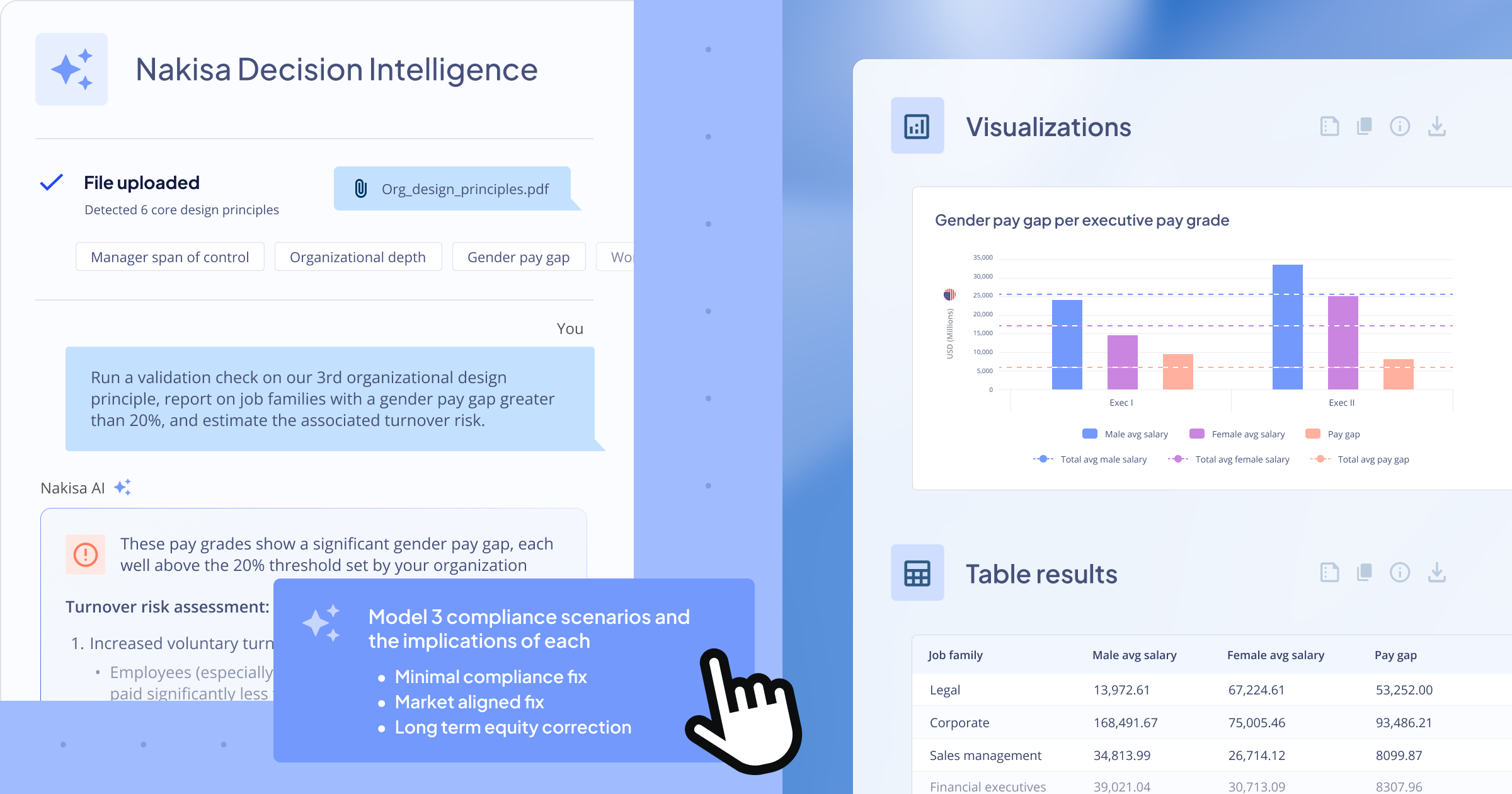
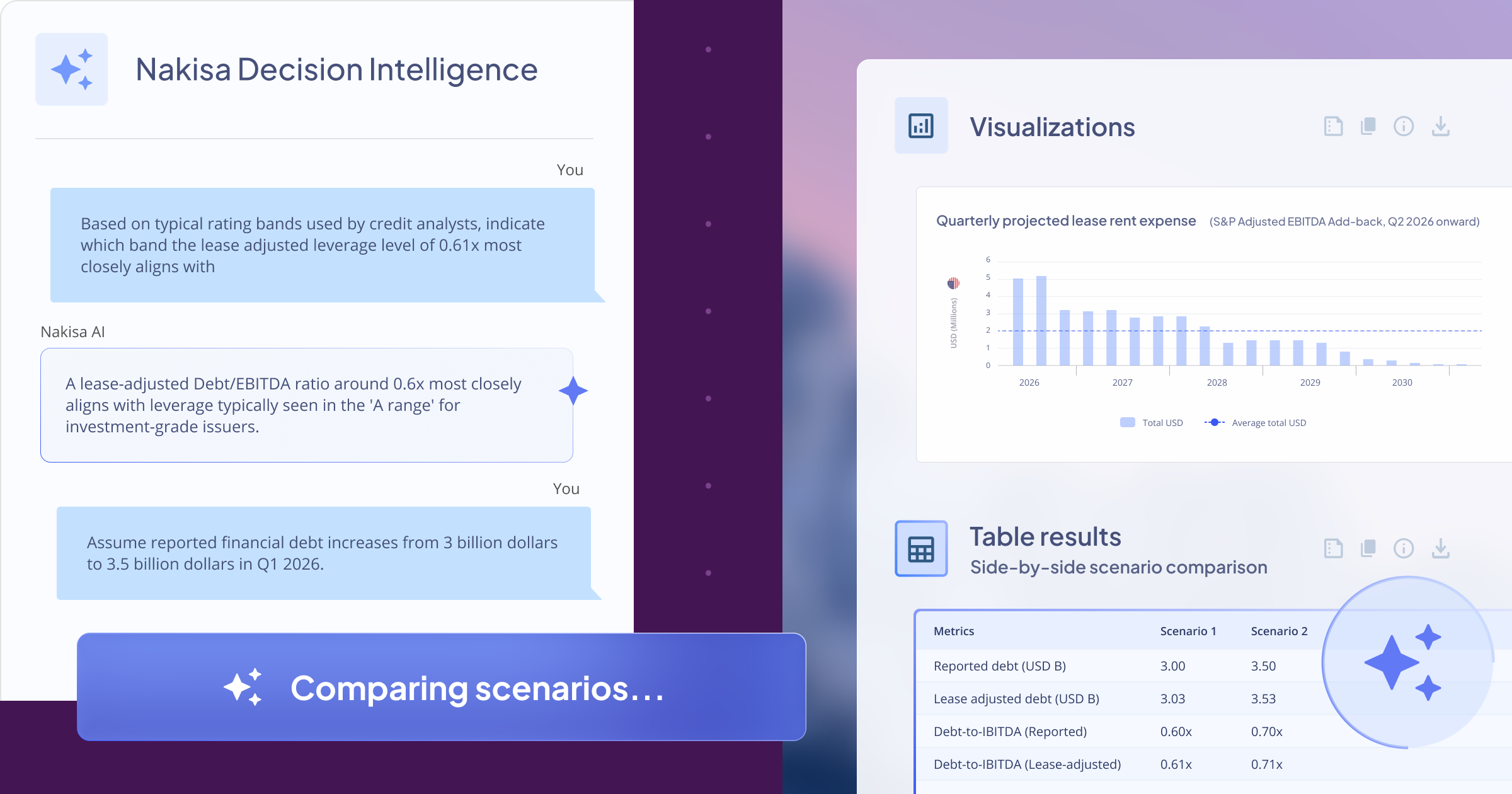
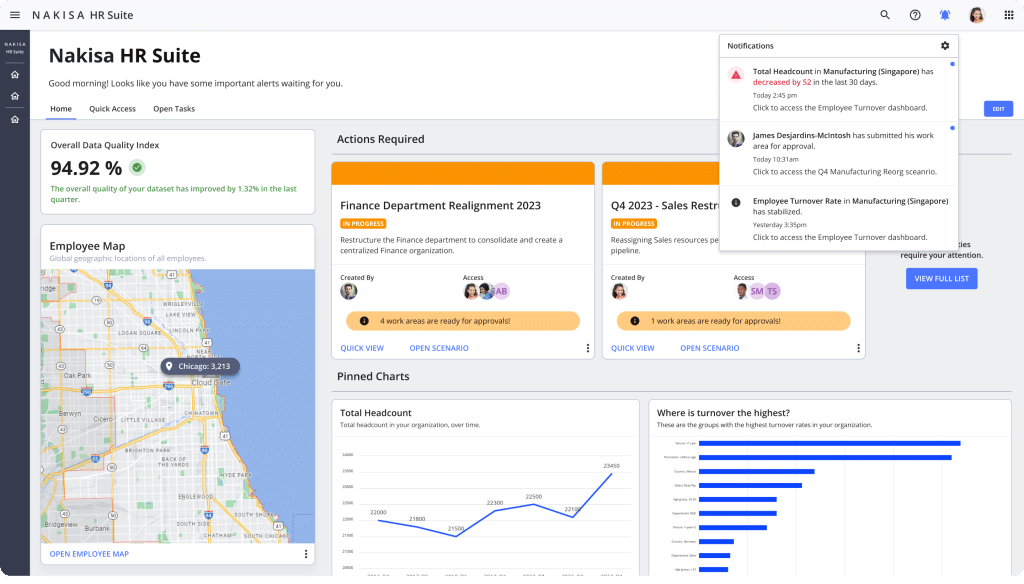
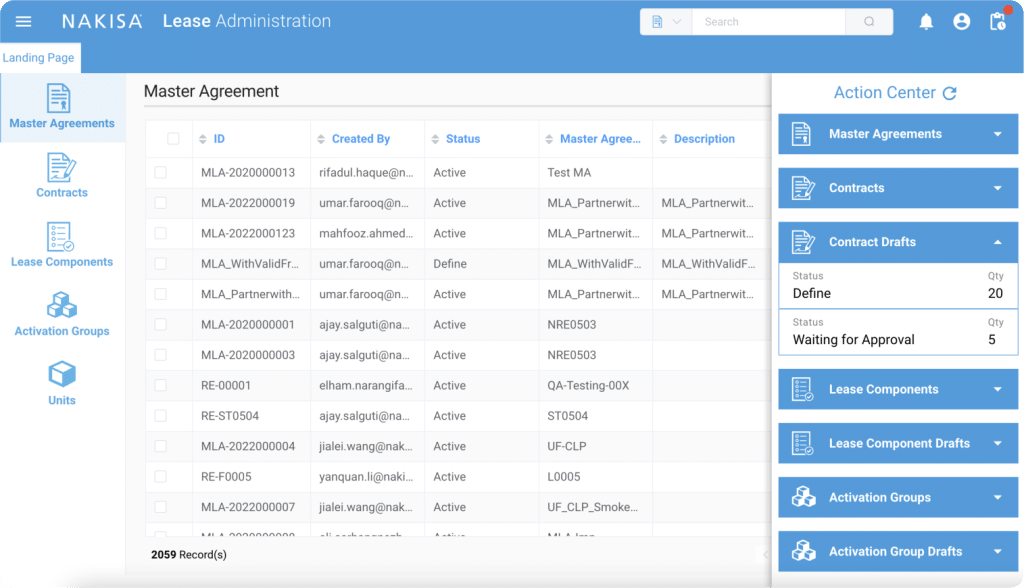
The CSA report focuses on national-scale intelligence: trade flows, Arctic surveillance, macroeconomic signals. Nakisa Decision Intelligence operates at a different layer. The organizational and resource layer where those national conditions translate into operational decisions. When a federal agency needs to model the workforce impact of a major restructure, right-size its real estate footprint against shifting hybrid work patterns or understand which budget misalignments are creating service delivery gaps, that's NDI's domain.
What connects the two is the underlying architecture of the problem. Whether you're tracking port congestion or modelling a departmental reorganization, the challenge is the same: fragmented data, slow synthesis, and decision-makers who need to act before the picture is complete. NDI's agentic approach, surfacing root causes, not just patterns, and prescribing prioritized actions rather than dashboards, is built specifically for that environment. Critically, it is designed around the same principle Goldfarb identifies as the condition for trustworthy AI adoption: keeping humans in the loop. Decision-makers review, adjust, and approve AI-generated recommendations before any action is taken. That is not a constraint on NDI’s capability. It is what makes the output defensible in a government context. Our work with the City of Oshawa illustrates what this looks like in practice: facing fragmented, manually-maintained org charts across departments and no reliable city-wide view of its workforce structure, Oshawa used Nakisa to centralize that information into a single, real-time source, giving decision-makers accurate organizational data within a security framework that meets Canadian government standards.
Conclusion
The report closes with a clear-eyed warning: Canada risks becoming dependent on intelligence produced elsewhere if it doesn't invest now. US statistical agencies are being defunded and politicized — and because the US economic outlook feeds directly into Canadian forecasting, that is Canada’s problem too. Arctic monitoring programs that Canada counted on are gone. Supply chain intelligence is being built by private logistics firms and foreign governments while Canada runs piecemeal customs modernization projects that don't add up to a unified capability.
The agencies that close this gap in the next few years will be the ones that solved two problems simultaneously: the capability problem (agentic AI that synthesizes and prescribes, not just visualizes) and the trust problem (certified, sovereign, human-in-the-loop). Those two things are available together now. The question is whether organizations move from pilots to production while the window is open, or wait until the intelligence gap has widened further.