New integration connects Nakisa Decision Intelligence (NDI), IWMS, Lease Accounting, and Workforce Planning to the Databricks Platform — querying data in place and adding a governed decision layer.
MONTREAL, Canada – July 28, 2026 – Nakisa today announced a new integration between its enterprise solutions and the Databricks platform. The integration includes: Nakisa Decision Intelligence (NDI), Nakisa IWMS, Nakisa Workforce Planning, and Nakisa Lease Accounting. Nakisa solutions connect to Databricks via API and SQL, query customer data in place — without moving, copying, or replicating it — and complement customers’ existing Databricks Lakehouse investments.
The integration adds a governed decision-intelligence layer on top of the Databricks Data Intelligence Platform — connecting Lakehouse data with the ERP, HCM, CRM, and external market and regulatory signals that continue to live outside Databricks — so that decisions can be made, approved, executed, and audited across the full enterprise landscape.
Enterprise decisions on top of the Lakehouse — and the systems around it
Nakisa Decision Intelligence (NDI) is built on a simple premise: enterprise decisions improve when AI analysis of internal data and external market signals is governed, connected across systems, and carried through to accountable action. Databricks customers rarely operate in a Databricks-only environment. Decision-critical data continues to live in ERP, HCM, CRM, external market and regulatory sources, and specialized operational systems that are not — and in most cases will not be — landed in the Lakehouse.
Independent analyst research supports this model. Verdantix highlights that enterprise AI agent platforms are especially relevant in “fragmented environments with unclear decision logic,”1 where work spans multiple systems, data sources, tools, and human judgment points. The report also notes that orchestration can create “a single process state that spans systems,” reducing the need for users to switch between applications, copy information manually, or stitch together outputs from separate agents. For enterprises running the Databricks Data Intelligence Platform as their analytical and AI foundation, this is precisely the gap NDI closes: a governed decision-intelligence layer that reads from Databricks in place, joins Lakehouse data to the ERP, HCM, CRM, and external signals that live outside it, coordinates cross-system workflows, supports contextual decision-making, and preserves traceability from analysis through to approved action. 1
1 Source: Strategic Focus: Five Essential Questions When Selecting An Enterprise AI Agent Platform – Verdantix Research April 2026 by Aleksander Milligan with Chris Sayers.

Databricks customers have made a significant investment in consolidating their enterprise data within the Lakehouse to support analytics and AI. By integrating directly with the Databricks Lakehouse, Nakisa can securely consume the data customers have already unified, without requiring them to build and maintain the same integrations twice. Where relevant data has not yet been consolidated in Databricks, Nakisa can also connect to those out-of-band systems and bring that information into its decision intelligence platform.
This gives customers a governed and traceable decision layer across both their existing Lakehouse foundation and the additional enterprise data required for each decision.

Faraz Ahmed
Chief Technology Officer at Nakisa
Nakisa’s Integration Strategy
Nakisa extends the value of Databricks, ERP, HCM, CRM, and the data platforms enterprises rely on — by connecting to data where it already lives.
Traditional integration moves, transforms, synchronizes, or replicates that data. With the Databricks Data Intelligence Platform, Nakisa takes a different approach: it connects via API and SQL and queries data in place, so customer data stays in the customer’s Databricks environment under the customer’s existing governance and security policies. Nakisa Decision Intelligence (NDI) then adds a governed decision-context layer that identifies which sources matter, how records relate across Databricks and non-Databricks systems, where trends or anomalies are emerging, what thresholds or policies apply, and what evidence should be preserved before action is taken.
Databricks customers still operate across systems Databricks does not. Enterprise decisions typically require signal from SAP S/4HANA, SAP ECC, Oracle ERP, Workday, SAP SuccessFactors, Salesforce, ServiceNow, and external market, regulatory, labor market, macroeconomic, and ESG data sources. NDI connects to those systems through the same governed integration layer, bringing disconnected internal data, Lakehouse data, and external signals together for cross-system decision-making — without asking customers to consolidate everything into a single platform, and without duplicating what already lives in Databricks.
NDI adds the decision infrastructure around that foundation: cross-system context, signal detection, governed human review, approved write-back into ERP and HCM where enabled, and a preserved decision record showing the evidence, assumptions, approvals, and rationale behind each action.
Enterprise decision intelligence in action
While Databricks provides an analytical and AI foundation, enterprise decisions often require context from operational systems, business processes, and external data sources. Nakisa Decision Intelligence (NDI) connects these worlds together, combining Databricks insights with enterprise application data to support governed decision-making, scenario modeling, approvals, execution, and auditability.
Lease accounting: lease renewal and portfolio optimization
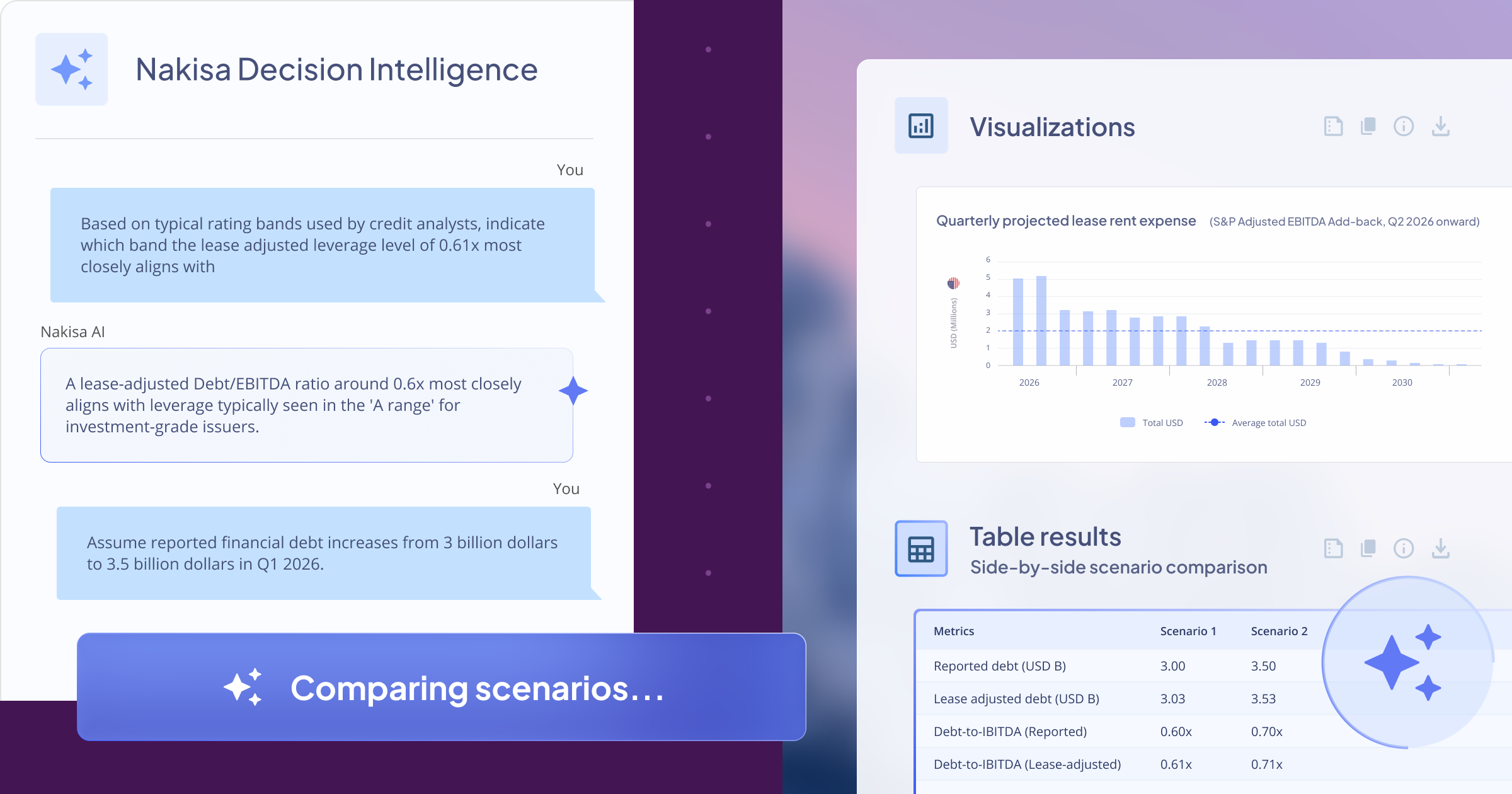
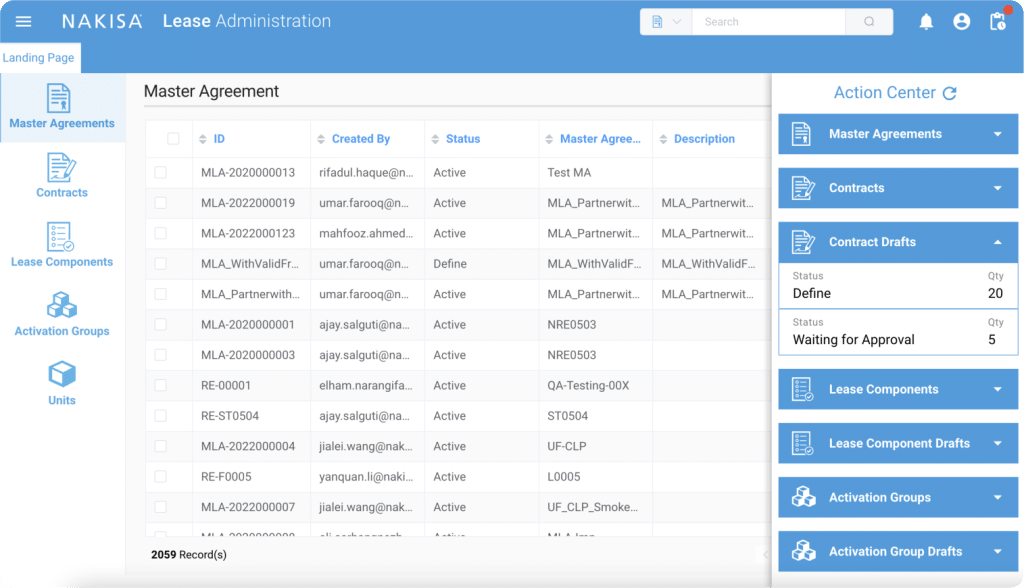
Nakisa Lease Accounting manages lease contracts, obligations, payment schedules, compliance requirements, accounting treatments, and portfolio data. Embedded Nakisa Decision Intelligence can enrich that information with business and operational signals available through Databricks, including profitability analytics, customer demand forecasts, supply chain metrics, production volumes, sustainability data, and predictive business forecasts.
For example, when evaluating whether to renew, expand, consolidate, or exit a facility lease, NDI can combine lease data from Nakisa with business-performance and forecasting data from Databricks to model multiple scenarios, quantify trade-offs, support stakeholder approvals, and preserve a complete decision record.
Integrated workplace management (IWMS): real estate portfolio decisions
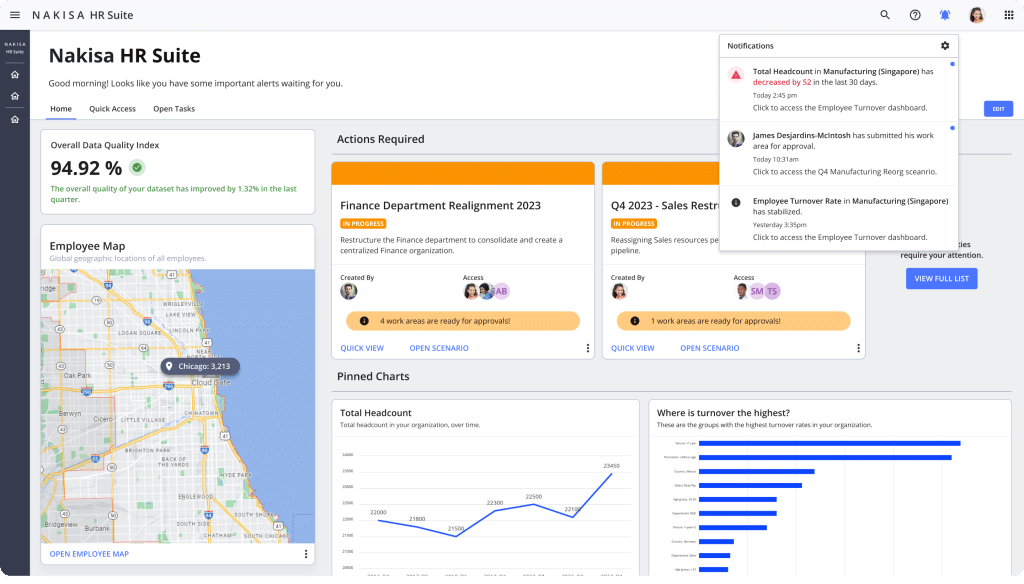
Nakisa IWMS manages portfolio, occupancy, facilities, maintenance, lease, workplace, and space-planning data. Embedded Nakisa Decision Intelligence can incorporate additional enterprise signals from Databricks, such as building utilization analytics, workplace attendance trends, operational cost data, ESG metrics, geographic demand forecasts, and business growth projections.
For example, when assessing whether to consolidate office locations, expand capacity, repurpose space, or defer investment, NDI can evaluate the impact of each option using both workplace and business-performance data, helping organizations make decisions that balance utilization, cost, employee experience, and future growth requirements.
Workforce planning: organizational and talent decisions
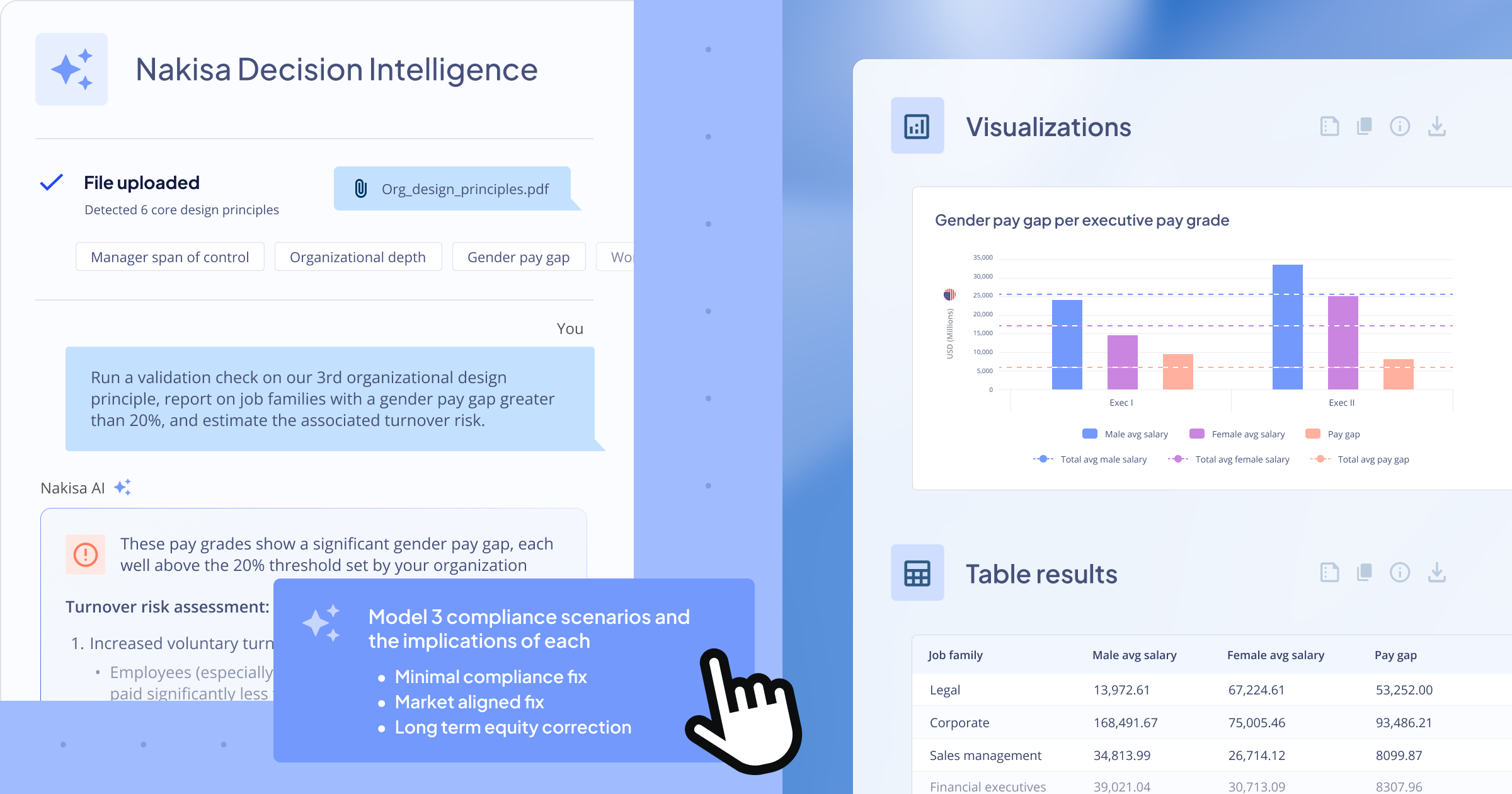
Nakisa Workforce Planning manages organizational structures, workforce models, positions, reporting relationships, compensation assumptions, and strategic workforce scenarios. Embedded Nakisa Decision Intelligence can augment that information with business and market intelligence available through Databricks, including revenue forecasts, sales pipeline analytics, customer-demand projections, production plans, labor-market intelligence, economic indicators, and predictive workforce models.
For example, when leadership teams evaluate hiring plans, workforce redeployment, geographic expansion, or automation initiatives, NDI can combine workforce-planning data with business forecasts and external market signals to compare scenarios, assess risks, evaluate trade-offs, and guide decisions with a clear record of supporting evidence and approvals.
Availability
Nakisa solutions with Databricks integration are production-ready and available today.
About Nakisa
Nakisa is an enterprise software company that helps the world’s largest organizations manage high-value decisions about their most important assets: their people, real estate, equipment, and financial commitments. For over 20 years, Nakisa has served Global 2000 enterprises — including large public sector organizations — across real estate portfolio management, lease accounting and compliance (IFRS 16, ASC 842, GASB 87, and local GAAP), and workforce planning and organizational design. Today, more than 200 enterprise customers rely on Nakisa to manage complex, multi-entity operations at scale, including Exxon, Nestlé, Pfizer, Puma, Volvo, Allied Irish Banks, and Ontario Power Generation. Nakisa’s workforce planning platform is used by 6.6 million users across 135 countries, and its finance platform manages approximately $1 trillion in right-of-use asset value globally — spanning more than 1 million leases across real estate, fleet, IT, and other specialized asset classes, and over 250 million square feet of active real estate footprint. Nakisa Decision Intelligence is both the AI layer embedded across the full platform and a standalone solution, enabling any enterprise team to move from data and insight to executed action across any domain.
Frequently asked questions
How can organizations use Nakisa Decision Intelligence (NDI) with Databricks data?
Organizations can use Databricks as their analytical and AI foundation while using Nakisa Decision Intelligence (NDI) to turn insights into governed business decisions. For example:
- NDI can combine lease-accounting data from Nakisa with profitability forecasts, customer-demand trends, and supply-chain analytics available through Databricks to support lease-renewal and portfolio-optimization decisions.
- In real estate and workplace management, NDI can combine occupancy, facilities, and lease data from Nakisa IWMS with workplace-attendance trends, operational-cost analytics, ESG metrics, and geographic growth forecasts from Databricks to evaluate consolidation, expansion, and space-planning scenarios. In workforce planning,
- NDI can combine organizational and workforce data from Nakisa with revenue forecasts, sales-pipeline analytics, labor-market intelligence, and business-growth projections from Databricks to compare hiring, redeployment, automation, and expansion strategies.
What is Nakisa’s Databricks integration?
Nakisa’s Databricks integration connects its enterprise solutions — Nakisa Decision Intelligence (NDI), IWMS, Lease Accounting, and Workforce Planning — to the Databricks Data Intelligence Platform. Nakisa connects via API and SQL and queries customer data in place, without moving, copying, or replicating it, adding a governed enterprise decision-intelligence layer on top of the Databricks Lakehouse.
What is enterprise decision intelligence?
Enterprise decision intelligence turns AI analysis of internal and external data into governed, accountable action across the business. Nakisa Decision Intelligence (NDI) provides a governed decision layer that connects data across systems, applies policies and thresholds, supports human review, and preserves a traceable record from analysis through to approved, executed action.
How does Nakisa connect to Databricks?
Nakisa connects to the Databricks Data Intelligence Platform via API and SQL and queries data in place. Customer data stays in the customer’s Databricks environment under existing governance and security policies — Nakisa does not move, copy, replicate, or transform it.
Which Nakisa solutions integrate with Databricks?
Four solutions integrate with Databricks: Nakisa IWMS, Workforce Planning, Lease Accounting, and Decision Intelligence (NDI). All connect through the same governed integration layer and are production-ready today.
How is Nakisa’s Databricks integration different from traditional integration?
Traditional integration moves, transforms, synchronizes, or replicates data. Nakisa instead queries data in place and adds a governed decision-context layer that identifies which sources matter, how records relate across systems, where trends or anomalies are emerging, and what evidence should be preserved before action is taken. The result is an accountable enterprise decision, not just an analytics query.
Does NDI work only with data in Databricks?
No. Enterprise decisions usually require signal from systems outside the Lakehouse. NDI also connects to SAP S/4HANA, SAP ECC, Oracle ERP, Workday, SAP SuccessFactors, Salesforce, ServiceNow, and external market, regulatory, labour market, macroeconomic, and ESG data — bringing Lakehouse data, internal systems, and external signals together for cross-system decision-making.
Does customer data stay secure and governed?
Yes. Because Nakisa queries data in place, customer data remains in the customer’s Databricks environment under the customer’s existing governance and security policies. NDI preserves a decision record of the evidence, assumptions, approvals, and rationale behind each action.
Is the Databricks integration available now?
Yes. Nakisa solutions with Databricks integration are production-ready and available today.